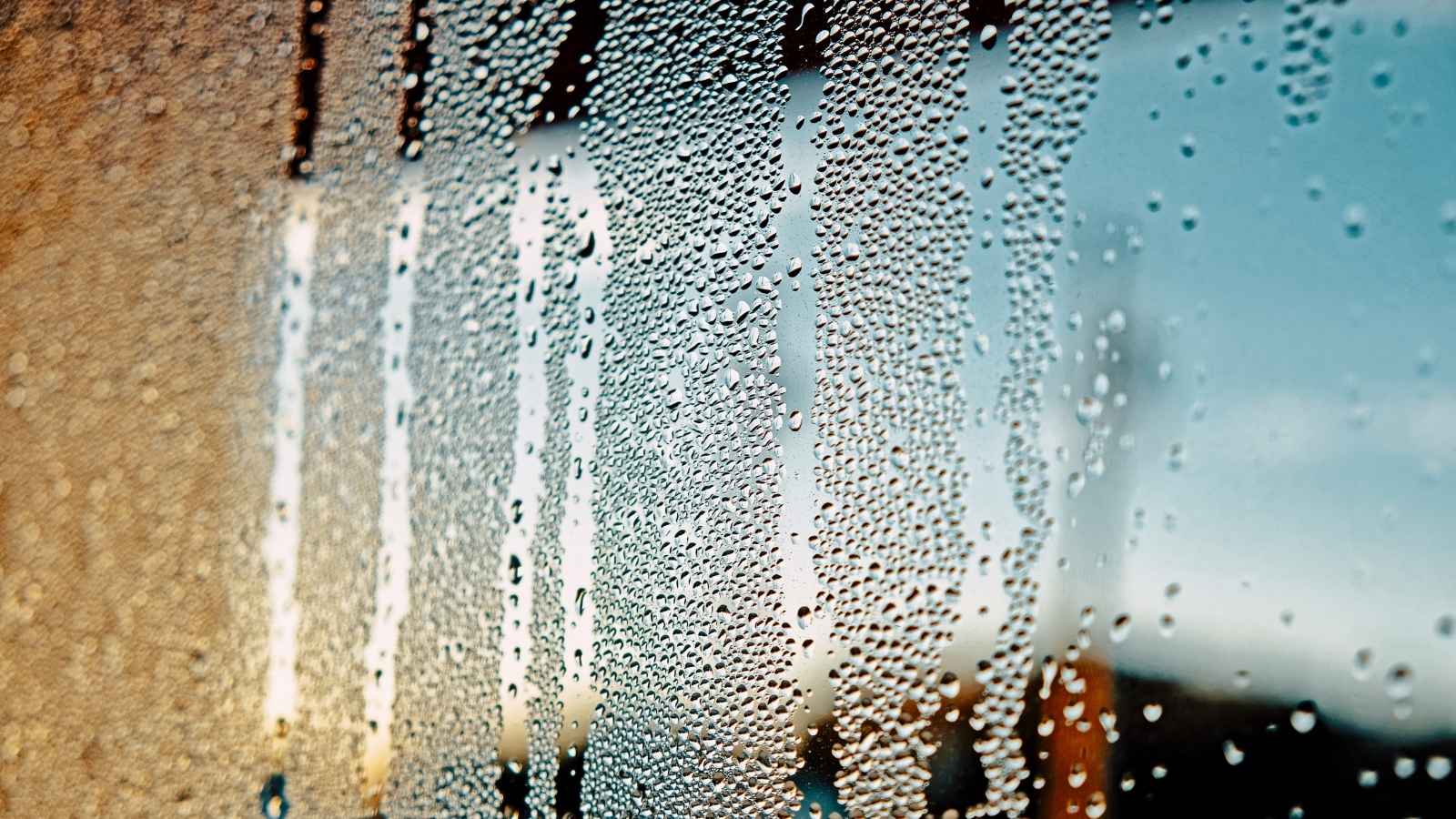

Suffering from condensation moisture?
Condensation moisture in the home can cause a lot of unpleasant consequences. How do you recognise this moisture problem? What are the consequences? And what can you do about it? We tell you all about it here.
Quickly find your answer:
Free diagnosis
Not sure whether you suffer from condensation dampness? Our experts will be happy to help. Via a free moisture analysis, we can determine exactly what problem you are facing. After all, a good moisture diagnosis is essential to find an appropriate solution.Contact our specialists for more info.
What is condensation moisture?

Natural process
Condensation moisture is a natural process that occurs in most homes, although it is not always a problem. Condensation moisture occurs when moist, warm air comes into contact with a cold surface, where the air then condenses. On those cold surfaces, that warm air forms droplets and thus becomes liquid.

Different surfaces
You usually see condensation moisture on windows and on mirrors. These are examples of when condensation is not a moisture problem. But, condensation moisture does not only adhere to windows and mirrors. It adheres to all kinds of (cold) places, including porous surfaces such as a wall. This is when condensation moisture does become a moisture problem.
Causes of condensation moisture
Condensation occurs mainly in rooms with high humidity, which are not (or cannot be) properly ventilated and where the moisture present in the air does not find an outlet. Condensation can also occur on exterior walls. In that case, a thermal bridge the problem. The most common causes are as follows:
1. Indirect sources of moisture as the breathing and perspiration of occupants. 2. Direct sources of moisture such as cooking, washing, drying laundry, mopping, areas with many plants, washing up, showering, bathing or water heaters without drains.
What are the consequences of condensation moisture?
Condensation has a lot of effects on your health and your home.
So, as you can see, you really need to have a moisture problem due to condensation moisture tackle.
How to recognisecondensation moisture?
Condensation moisture is often quite easy to identify. You can speak of condensation moisture if you notice the following:
Dissolving condensation moisture
For condensation moisture, one major solution applies: ventilate. You can try to take action here yourself by regularly opening your windows or installing moisture-eaters. But, not all rooms can be naturally ventilated equally well, so sometimes the solution is to have a mechanical ventilation. Such a ventilation system removes hot and humid air and is a systematic and sustainable solution. Did you install a balanced ventilation system? Then it also brings in fresh air.
Ventilation in the fight against condensation... and viruses
Ventilation not only has the advantage of helping condensation moisture get out of your house. With a little modification, you can also have ionisation installed in that ventilation.

That technology purifies your home of all the particles you don't want to breathe, such as particulate matter and pollen. But it also purifies the air of germs such as viruses.So do you want to tackle the condensation moisture problem while purging the corona virus from the air? Then a balanced ventilation with ionisation is the perfect choice.

For that ventilation, Aquaconsult works with the company Aeroconsult. They specialise in air conditioning and ventilation and are the only company that installs ionisation technology in homes. Technology that, by the way approved by the Belgian government. All for healthy living!
Do you suffer from condensation moisture?
Then contact Aquaconsult and our specialists will visit for a free moisture assessment, everywhere in Flanders.
More information and brochure request
Answer the questions below and get more information and our brochure based on them.

AquaConsult
Moisture problems
Moisture solutions
Frequently asked questions about condensation
With condensation dampness, it is important to reduce humidity in the house and provide adequate ventilation. Ensure that damp air can be quickly ventilated after showering, cooking or doing laundry by opening the window or using a well-functioning ventilation system. If the condensation problem persists, then it is a structural problem that should be solved professionally to prevent mould and other moisture damage.
Condensation moisture occurs when warm, moist air comes into contact with colder surfaces in the home and then starts to condense into water droplets. This natural process is often visible on windows, mirrors and even walls. When humidity levels in the home are too high combined with inadequate ventilation, it can lead to a condensation problem.
You can recognise condensation dampness by water droplets on the windows, damp walls or a musty smell in the house. Mould on window frames, walls or ceilings is also a common sign.
Condensation moisture is not always serious. However, it can become harmful if it is present for a long time. Persistent condensation moisture can lead to mould growth, health problems and damage to walls, paint and plaster. Therefore, it is important to address a condensation problem in time.
Your windows are wet in the morning or after showering because the warm, humid air in the house cools against the cold glass. This causes the water vapour to condense into water droplets that wet the windows. So why does this happen in the morning or after showering? During the night, your breathing creates moisture while the windows are cooling. This creates a temperature difference resulting in the condensation moisture. And after showering, the humidity rises shortly, due to the warm steam, causing this moisture to settle on the colder surfaces like the windows or mirrors. Occasional condensation moisture on the windows is normal, but when it occurs daily and especially over a long period of time, or when mould and a musty smell develop, it indicates a bigger condensation problem.
You can prevent condensation in your home by ensuring adequate ventilation, thereby reducing the humidity. This stops the damp air from building up and turning into condensation. Everyday activities such as cooking, showering and even breathing introduce moisture into the home. This moisture can also settle on cold surfaces if it cannot be removed. By ensuring rooms are adequately ventilated, you can try to prevent condensation or reduce the likelihood of it forming. However, you cannot always assume that this will be sufficient. Also try to ensure a stable temperature in the house. Make sure you have ventilation options in rooms where it is needed, such as the bedroom, bathroom, kitchen, etc. If the condensation moisture keeps coming back, then there is often a structural ventilation problem and a professional is needed to address the moisture problem and bring it to a head.
Condensation moisture occurs when warm, humid air in the home comes into contact with cold surfaces, causing it to cool into condensation or water droplets. This mainly happens at times when the humidity rises sharply, such as when washing clothes. The greater the temperature difference between indoors and outdoors, the faster condensation occurs.
In winter, you fight condensation moisture by ventilating sufficiently, whenever possible, and heating your home evenly. That way, moist air cannot accumulate and the temperature difference remains limited. During cold periods, the difference between the outside and inside temperature is greater, so condensation moisture forms more quickly. The windows then stay closed longer and the moisture stays around in the house. Still, try to ventilate daily to let the damp air escape, without your home cooling down quickly. It is also important to heat your home at a stable temperature rather than allowing large temperature variations. Be sure to pay extra attention to important rooms where people live a lot, such as the bedroom, bathroom and kitchen. These are therefore the places in the house where condensation moisture is most likely to occur.