



Advantages of concrete injection
Free analysis
Are you suffering from a damaged or damp concrete wall? Get assistance from our moisture experts. Our experts will visit you free of charge and without obligation. Take contact at for additional information.
Concrete injection: the solution to moisture problems in concrete walls
Cracks can appear in concrete structures, such as facades and walls, because of various reasons. These cracks can lead to moisture and stability problems, affecting the health of the concrete. If a damaged concrete wall is not treated, brittle concrete, loose pieces of concrete, concrete rot and moisture problems occur.
Concrete injections are an effective method for repairing, strengthening and waterproofing concrete walls. This technique involves injecting an injection fluid into the concrete. They repair and fill concrete cracks, concrete seams, gravel nests and voids, restoring the concrete to its original strength.
How do moisture problems occur in concrete walls?
Moisture problems in concrete walls often occur as a result of cracks in the wall, which in turn can be caused by various acting forces. Some possible causes include the following:
When the stress exceeds the resistance of the concrete, cracks appear. This can also cause moisture problems arise. For example, the wall can no longer properly hold back rainwater from outside or groundwater, leaving you with penetrating moisture, rising damp or a damp cellar.
How does concrete injection work?
There are different methods and injection fluids when it comes to concrete injection. Which method best suits your situation depends on the cause of the damaged concrete wall and the purpose of the repair. This is best done by a moisture specialist examined.
Typically, having concrete injected has the following steps:
Concrete injections with AquaConsult

AquaConsult makes concrete walls bone-dry again with its concrete injections. We exclusively inject the robust ARTIPUR INJECT FLEX: a product developed to seal joints and cracks in concrete structures, even in the case of leaks with a high water flow rate and pressure. After this procedure, no drop of water can enter the interior space through the concrete wall.

ARTIPUR INJECT FLEX is a 1-component polyurethane injection resin catalysed with ARTIPUR CAT FLEX. The dosage of the catalyst determines the polymerisation time. In liquid phase, this product is a yellowish, transparent liquid that cures rapidly (depending on ambient temperature and catalyst dosage) in contact with water to form a tough, flexible closed-cell polyurethane foam.

Tip: Request your quote here or contact us for an expertise. On the basis of a no-obligation visit, we can obtain a personalised price calculation from one of AquaConsult's moisture experts-construction engineers. As the price depends on many factors, prices can only be calculated on a case-by-case basis and there is little point in communicating general rates. We are at your service all over Flanders. Want more information? Then be sure to download the brochure at the bottom of this page. In it, we explain all moisture control options in detail.
More information and brochure request
Answer the questions below and get more information and our brochure based on them.


AquaConsult
Moisture problems
Moisture solutions
Frequently asked questions about concrete grouting
The finishing of concrete, also known as basement This is achieved using a waterproof cement coating or flexible mortar. This method is ideal for providing superficial protection for concrete walls against constant groundwater pressure. Before the coating is applied, the substrate must be completely clean and free from active leaks, so that the barrier can adhere optimally to the inside or outside of the structure. Although applying a waterproof coating to concrete is an excellent preventative measure, it does not resolve underlying structural faults such as cracks or leaking formwork joints. If moisture has already penetrated deep into your home’s foundations, the built-up water pressure may cause the coating to peel away over time. In that case, we at AquaConsult recommend combining the application of a waterproofing coating with targeted concrete injection to achieve a permanent solution.
Inside professional damp-proofing We mainly distinguish between three types of injection fluids. Firstly, there are polyurethane (PU) injections, which expand rapidly on contact with water and are ideal for immediately sealing active leaks. Secondly, we also use epoxy injections. These resins harden completely and restore the original structural strength of cracked concrete. The third category consists of acrylic or gel injections. These injections form a flexible barrier within the micro-cracks or behind the wall. The type of injection treatment required for your home depends entirely on the cause. Is it a structural crack or simply water ingress? Our experts analyse your specific situation on site to determine the correct fluid, so that we can offer a long-lasting solution with a guarantee.
Yes, although concrete looks solid, it is by nature a porous material full of microscopic channels and capillaries. Certainly in certain regions Where the groundwater level is periodically very high, the concrete structure of the cellars is under constant pressure. Due to the suction effect of these pores, groundwater can slowly but surely seep deep into the floor or walls. And once the moisture has penetrated the concrete, this can eventually lead to serious damage to your home. Just think of mould, musty odours and even concrete decay, in which the internal steel reinforcement begins to rust and expand. Injecting the concrete or waterproofing it in good time is essential to protect the stability of the structure.
The main drawback of concrete injection is that it is a specialist, precision job. If the injection holes are drilled at the wrong angle or the concrete is injected at the wrong pressure, the internal concrete structure may be damaged. Furthermore, a localised injection only resolves the damp problem at the treated spot. If there is persistently high groundwater pressure around your home, the damp may, over time, find another weak spot to seep through. The initial costs of concrete injection using professional equipment and certified resins are also higher than those of temporary DIY solutions. However, for most residents, the disadvantages of concrete injection do not outweigh the benefits of this treatment. Thanks to the preliminary free expertise and with AquaConsult’s watertight guarantee, you can be sure that the moisture problem has been resolved once and for all.
The cost of concrete injection depends heavily on the severity of the moisture problem and the total area affected by the damage. On average, the cost of concrete injection starts at between €100 and €150 per metre. As many homes may be affected by specific groundwater levels and varying soil conditions, a free expertise It is essential to assess the current situation in advance. Factors such as the accessibility of the cellar and the type of injection gel or polyurethane resin will determine the final cost of making your home permanently watertight again. At AquaConsult, we therefore do not believe in a one-size-fits-all solution with standard rates. Instead, we believe in a bespoke moisture solution of your property at tailored prices. That’s why our experts always visit you, with no obligation, to a thorough moisture measurement as part of our free expertise. They’ll identify the exact cause of the damp problem and provide you with a bespoke quote, so you know exactly where you stand. You’ll benefit from a permanent solution with no surprises afterwards.
Following a successful concrete injection, the moisture problem The problem was stopped at source, but the moisture present did not disappear immediately. As a rule of thumb, a treated wall takes about one month per centimetre of wall thickness to dry out completely. For a typical Flemish external or cellar wall 20 centimetres thick, the drying process can therefore take between 2 and 4 months. This process is highly dependent on the humidity in your region and the extent of ventilation in space. During this drying period, it is important to leave the wall uncovered so that the trapped moisture can evaporate properly. After the treatment, our specialists will advise you in detail on the best way to speed up this process, for example through controlled heating or extra ventilation. Only once the wall is completely dry can you start the final finishing work, such as painting or plastering.
Self-compacting concrete against rising damp or a leak in the cellar is a job for specialists. Every situation is different, so the necessary expertise is required. The process begins by exposing the structure and carefully mapping out the cracks, potholes or weak spots in the concrete. Based on this analysis, the specialist selects the appropriate injection material. Depending on the cause and the aim of the repair, high-quality liquids such as epoxy are used for structural repair, or flexible polyurethane or acrylic to permanently stop the ingress of groundwater. Following the analysis and advice, holes are drilled into the concrete wall at strategic points. The chosen liquid is then forced into the concrete structure under high pressure through these holes. The liquid fills all invisible voids and cracks, after which it hardens and levels out. This ensures that all loose elements are once again perfectly bonded and sealed together. This not only stops the moisture problems in your home, but it also immediately restores the concrete structure to its original strength. As an incorrect assessment can make the damage worse, most residents leave this specialist job to our experts.
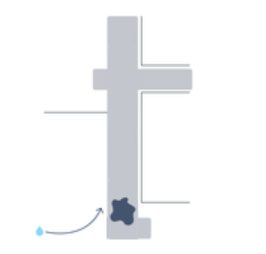
Concrete injection is an effective technique for restoring basements and concrete structures to a fully watertight and airtight condition. The method works on the basis of a chemical reaction. A liquid polymer, such as polyurethane or epoxy, is injected under high pressure into the cracks or voids in the concrete. As soon as this liquid comes into contact with the moisture in the wall, the material rapidly expands into a flexible or rigid foam. This foam fills every invisible micro-crack and forms an impenetrable barrier against groundwater. This technique is ideal if you don’t want any demolition or excavation work carried out. Everything is done from the inside out. Whether it’s a leak in the cellar wall, a cracked foundation or a damp joint between the floor and the wall, concrete injection solves the problem quickly, locally and permanently without compromising the stability of your home.