
Advantages
Free expertise
Not sure if basement drainage is the right solution for your situation? Do you need support? Our technical advisers have built up extensive experience and expertise to effectively determine how best to combat moisture. They are available to assist you free of charge and with no obligation. Do not hesitate to get in touch.
What is basement drainage?
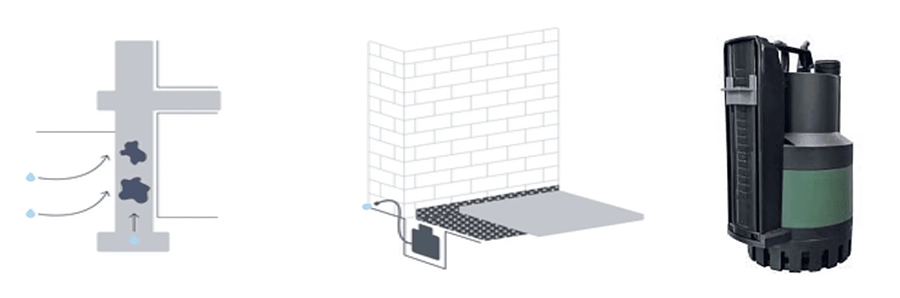
If you notice moisture or puddles of water in your basement, it is highly recommended to waterproof your basement. If you don't, sooner or later you will have to deal with the negative consequences of moisture problems. One way of waterproofing a basement is through basement drainage. This drains the groundwater that enters the cellar in a permanent way via channels. There are three types of basement drainage, depending on how the groundwater reaches the basement:
How does basement drainage work?
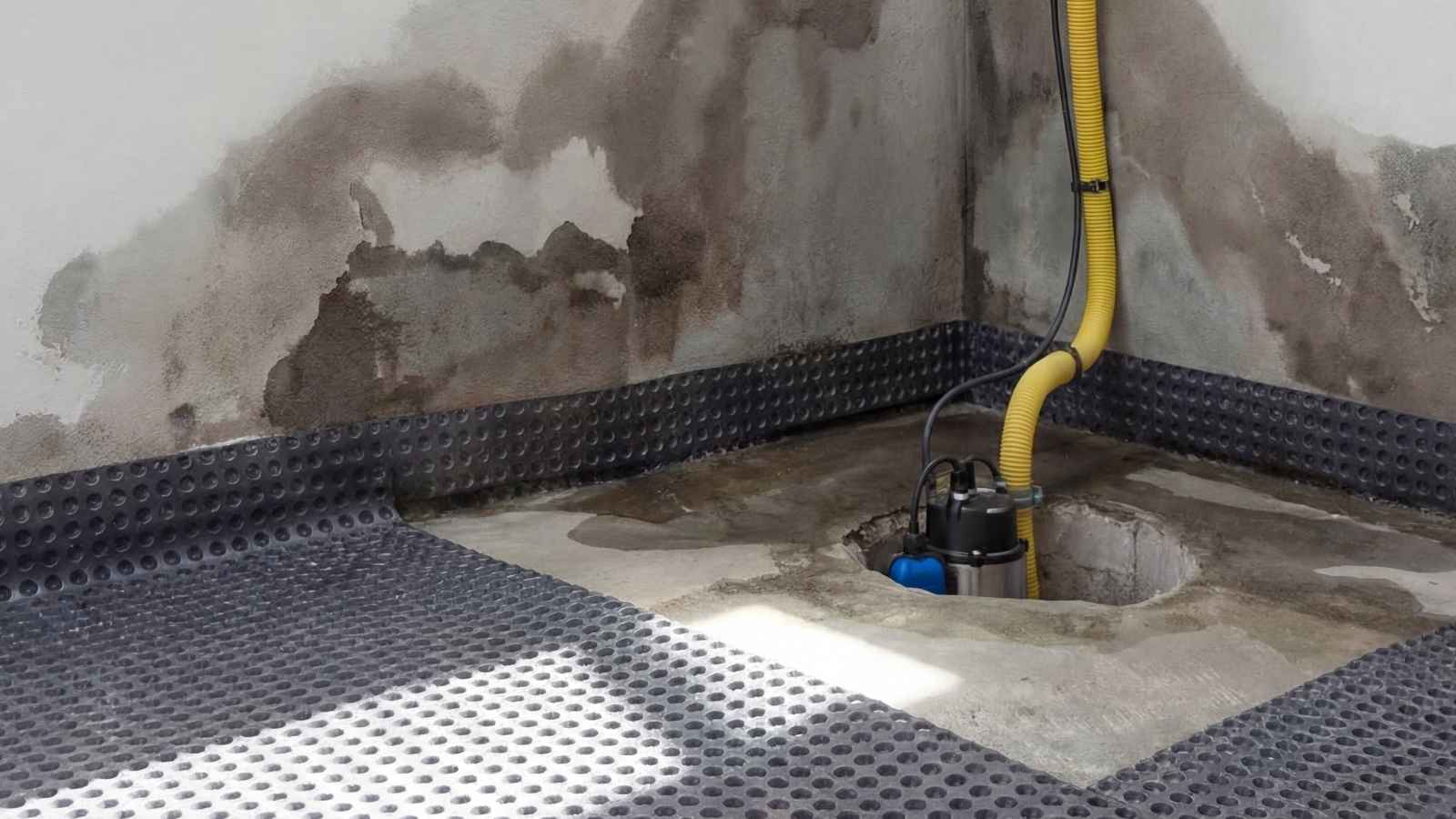
Whether you are dealing with a wall, edge, or floor drainage, the modus operandi of the moisture expert proceeds very similarly. In traditional floor drainage, a moisture expert usually installs a solid bubble wrap or bubble membrane, which is used to drain the groundwater:
By efficiently draining groundwater under this new floor, floor drainage is a sustainable solution that is also unobtrusive. After complete curing and drying of the new floor, the moisture problem is permanently solved. About 8 cm of height is lost in the process. It is wise to engage a specialist if you are considering basement floor drainage. This ensures a careful assessment and expert execution of the necessary work.
AquaConsult's unique process:
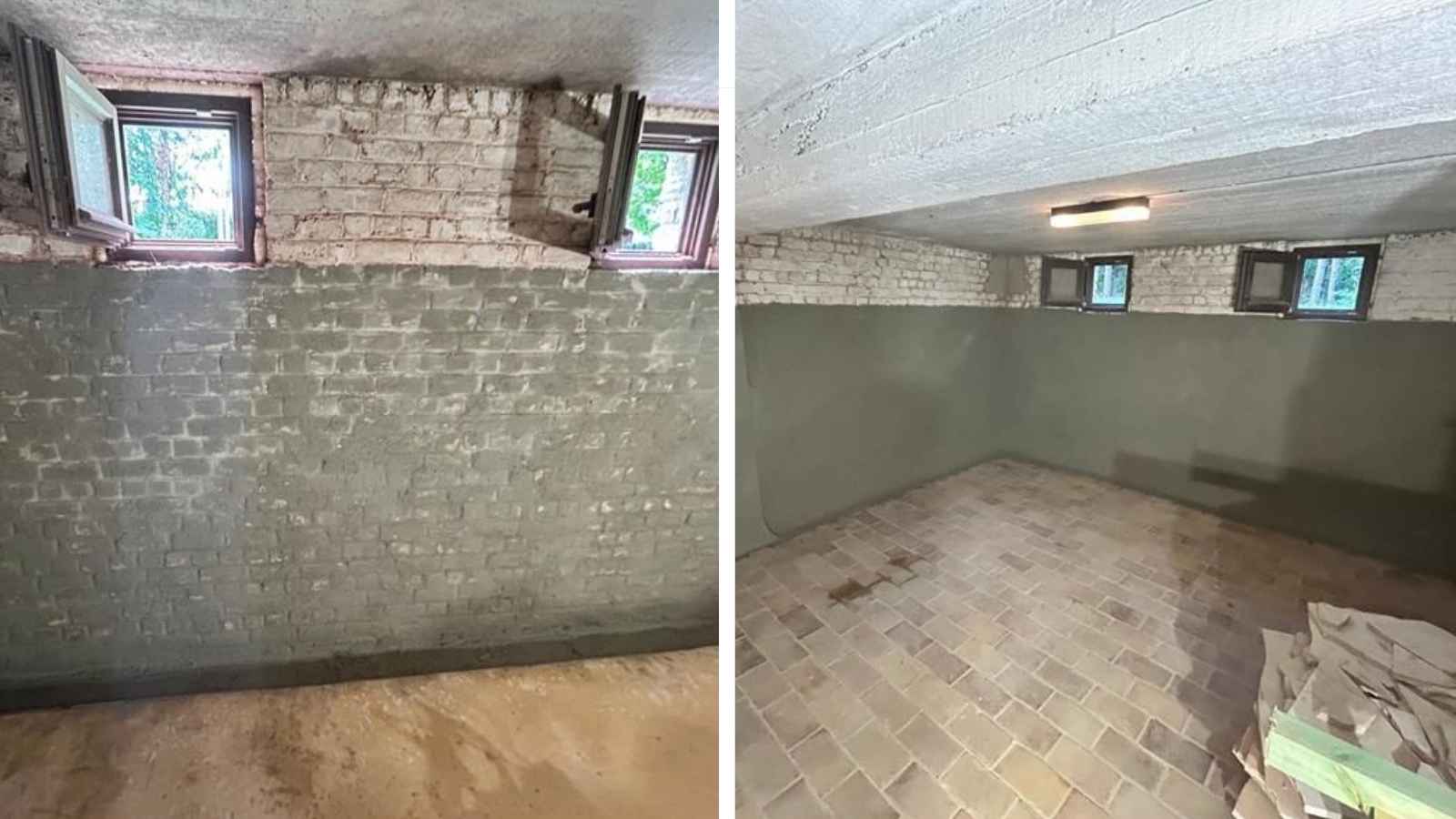
At AquaConsult, we have a certified alternative approach to floor drainage. Unlike adding a new layer of concrete above the bubble liner, as described previously, we use certified ceramic tiles.
More information and brochure request
Answer the questions below and get more information and our brochure based on them.


AquaConsult
Moisture problems
Moisture solutions
Frequently asked questions about basement drainage
Although concrete is a solid material, it is naturally porous and subject to the natural setting of the house. In regions with high groundwater level, such as the port of Antwerp or lower-lying polders, the hydrostatic pressure can become so great that water is literally forced upwards through the tiny capillaries and cracks of the concrete floor. This often creates a constant pool of water on the floor, even when the walls appear dry. Especially in older basements, where the floor slab is thinner or lacks a modern water barrier, this is a common problem. The solution to this is professional basement drainage, where a bubble membrane takes pressure off the concrete and safely drains the water. Without intervention, this rising water can affect the foundation and lead to concrete rot, compromising the stability of the entire house.
When draining a basement, the depth is determined by the construction of the floor slab and the lowest point of water infiltration. In most cases, drainage channels or drainage pipe are placed just below the level of the current basement floor and that often in a trench at the edge of the basement. It is crucial that the pipe is deep enough to catch the water before it reaches the floor, but not so deep that it affects the stability of the foundation. A correct gradient to the collection point is more important here than the depth. If the drainage pipe is not under the correct gradient, water will remain and blockages due to lime or silt will occur. As this is precision work, we always recommend a free expertise by one of our professionals.
To definitively get rid of moisture in the basement off, a two-pronged approach is needed: stopping the active water flow and regulating humidity. When there is seeping groundwater, basement drainage or basement the only structural solution. Once the water is drained or held back, the remaining water vapour must be dealt with via a high-quality ventilation system. Many homeowners are trying to the moisture problem solve with a temporary dehumidifier, but this is symptom control until the cause is addressed. At AquaConsult, we help our clients throughout Flanders with a total plan in terms of moisture control. A dry basement starts at correct diagnosis Of the cause whether it is rising damp, condensation moisture or infiltration.
The ideal humidity in a basement is between 40% and 60%. In an unventilated or untreated damp cellar this percentage often rises above 80%, which is the ideal breeding ground for fungi and the typical musty cellar smell. If the humidity is constantly too high, it can cause health problems for occupants and damage stored materials or the house structure. Measuring humidity values is a standard part of our free expertise. When humidity remains structurally too high despite basic ventilation, it is often a sign of a deeper underlying moisture problem with the groundwater. For a healthy indoor climate, if these values are exceeded, it is essential to call in an expert for a structural moisture solution.
Drainage of a basement is a process whereby infiltrating groundwater is collected in a controlled manner and discharged to the sewerage system. The most effective method is to place a studded membrane against the walls or on the floor of the basement. This membrane contains thousands of small channels that direct the water to a central point, namely the collection pit. From this manhole, a powerful, automatic submersible pump pumps the water to the sewerage system. Depending on where the leak is located, we choose edge drainage at the bilge seam (the connection between the wall and the floor), floor drainage or wall drainage. Unlike sealing the basement, which can lead to cracks when water pressure is very high, drainage allows the structure to breathe by removing hydrostatic pressure. Basement drainage is often the only sustainable solution for older houses in regions with saturated soils. As the installation of the pipes and pump must be done accurately to avoid blockages, AquaConsult always performs first a free expertise out to design a drainage system tailored to your home.
The main concern with basement drainage is its reliance on technology. Because the system relies on a submersible pump to actively drain the water, a power failure or pump malfunction can temporarily interrupt operation. AquaConsult catches this problem by working only with the highest quality pumps and, if required, installing an alarm system or back-up. In addition, the installation of drainage is a drastic moisture solution where the existing floor needs to be addressed. This may cause some temporary inconvenience due to breaking and dust. Another potential drawback is that basement drainage allows water to pass behind screens before it is effectively drained. This means that the system must be installed correctly by a specialist to avoid blockages caused by lime or silt in the drainage channels. Without regular maintenance of the pump and pipes, efficiency may start to decline in the long run. Nevertheless, these drawbacks and concerns do not outweigh the risk of permanent flooding, provided the implementation is done by an expert with a guarantee of results.
The price of basement drainage is determined by the area of the basement and the complexity of the installation. On average, the cost of professional basement drainage is between €2,000 and €5,500. This price includes not only the high-quality bubble membrane, but also the installation of the drains, the installation of the submersible pump and the reconstruction of the basement floor. Although this is an investment, it transforms an unusable, wet basement into a valuable and dry space. To make this investment manageable, AquaConsult offers the option of spread your funding of moisture control, while enjoying a dry basement yourself immediately. In addition, in Flanders you are also eligible for the My Renovation Premium, which can significantly reduce the net cost of basement drainage. For a specific price indication, ask a tailor-made offer to or do you take contact with our experts.
Yes, a drainage pipe is in many cases the most cost-effective investment for the life of your home. Without effective drainage, trapped water can create constant pressure on the foundation, eventually leading to concrete rot, mould and an unhealthy living environment in the rest of the house. By investing in a proper drainage system, you will avoid expensive repair works to the upper walls and floor structure. In addition, the resale value of your home increases significantly once the basement is officially certified as dry and usable. Instead of a damp storage space, you gain extra square metres of functional space. Combined with the available state premiums through the Flemish government and the possibility of staggered financing, the payback time of professional basement drainage is surprisingly short compared to the damage a damp basement does over time.