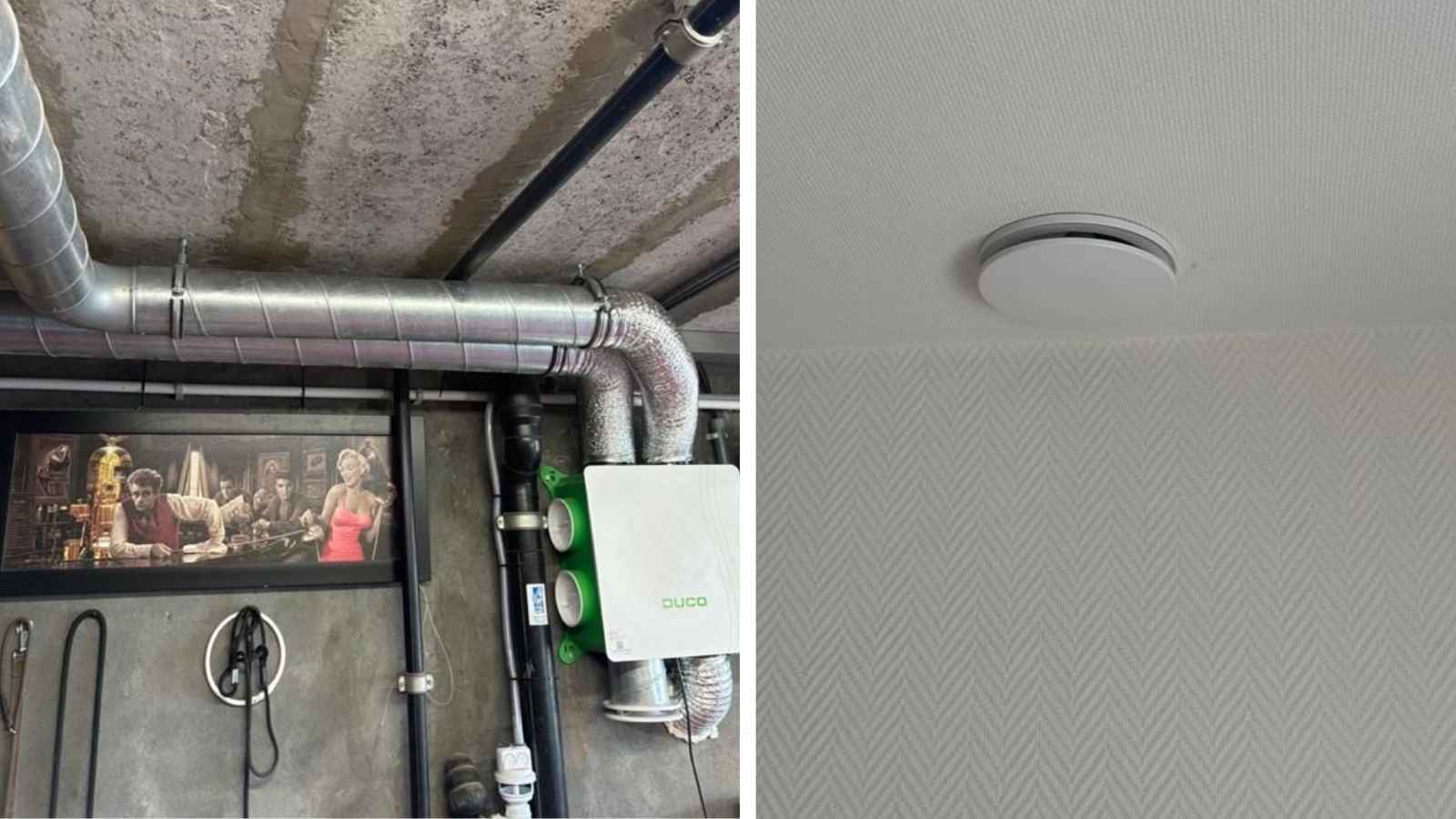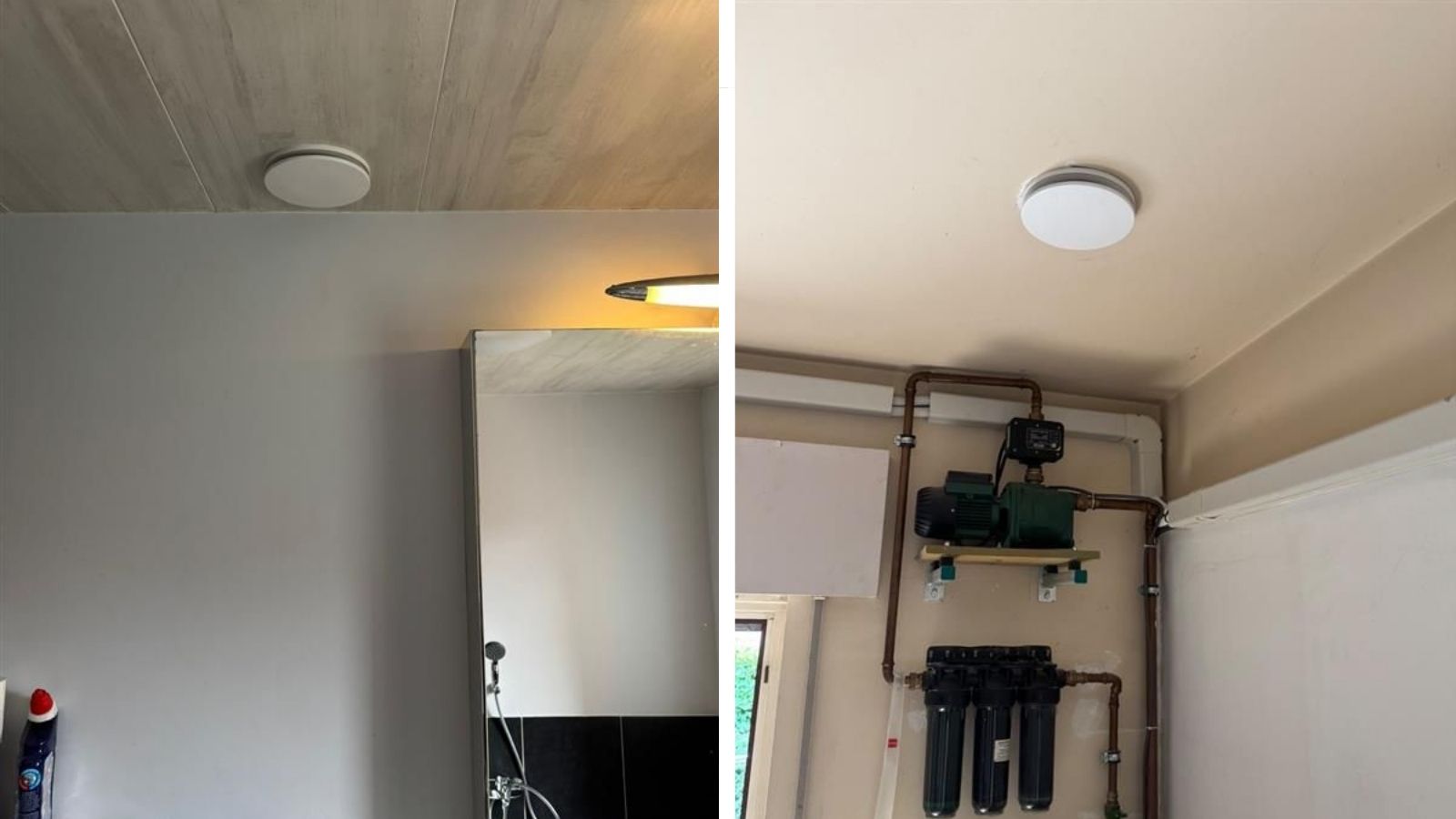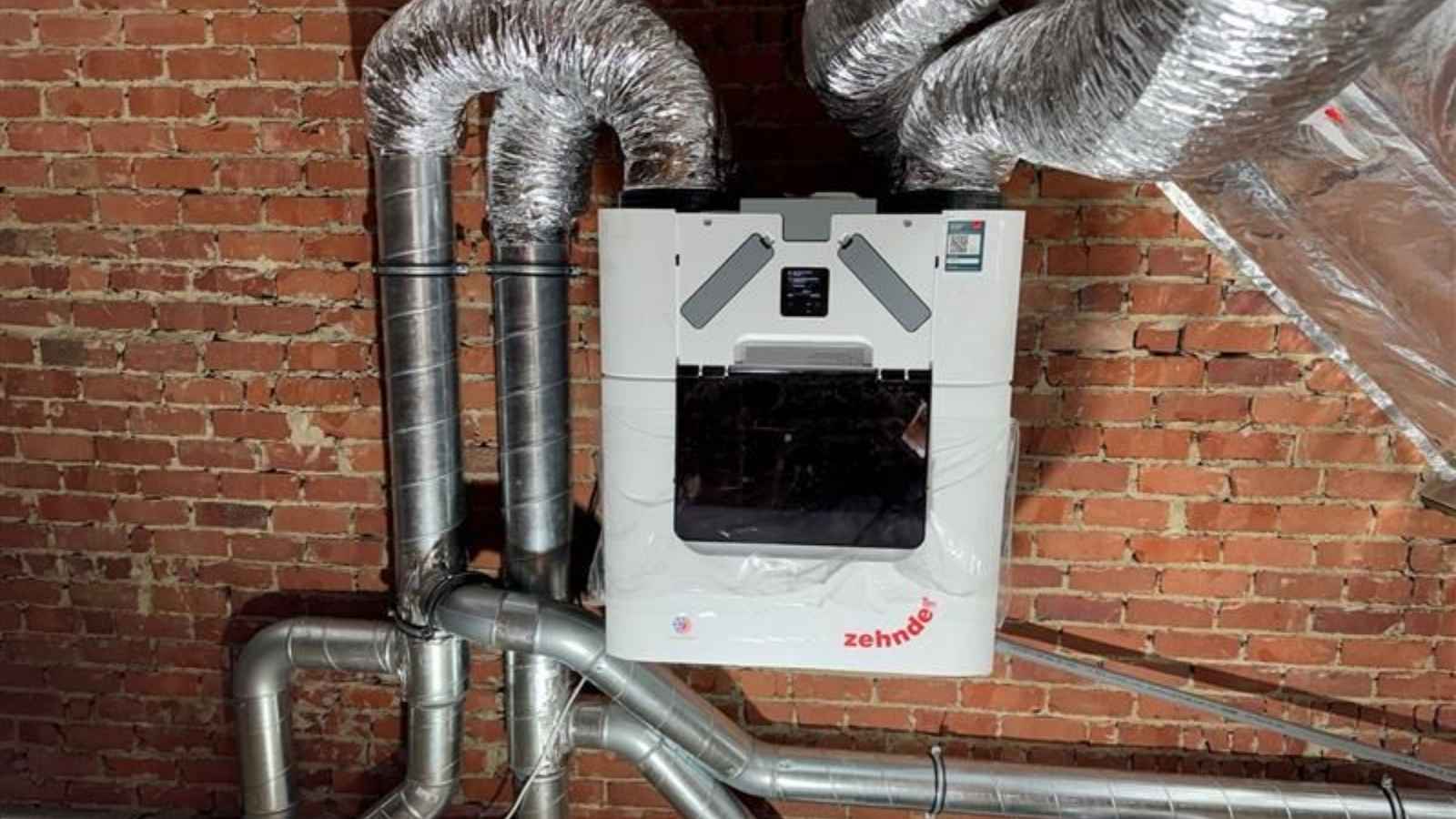

Advantages of a ventilation system D
Free analysis
Want to be absolutely sure about the type of moisture problem you are struggling with? Our specialists will visit you free of charge and without obligation. Contact our specialists for more info.
The importance of ventilation
The average Fleming spends most of his or her time indoors. Yet we find that indoor air quality is often significantly worse than outdoors. Not only can this lead to health problems, low air quality and high humidity can further cause humidity problems such as condensation moisture concerns. The solution? Adding a ventilation system to your home.
What types of ventilation systems exist?
There are four different types of ventilation systems: from Type A to Type D. Type A is entirely natural ventilation, whilst Type D is entirely mechanical ventilation. The most commonly used types in homes are Type C (semi-mechanical), which is more commonly used in basements, and Type D (fully mechanical). At Aquaconsult, we focus primarily on the fully mechanical ventilation. It therefore has numerous advantages.
A type D ventilation system
In a type D ventilation system, the supply and return air is fully mechanical via valves. It is also called a balance ventilation. That name comes from the fact that the system perfectly balances the air in the house. It offers complete control over how much air is exhausted and how much air is supplied. This is something you cannot achieve with other types of ventilation. A ventilation system D has numerous advantages:
Tip: be sure to check out Fluvius' Total Renovation Bonus. In fact, a ventilation system can be part of your BENO pass.
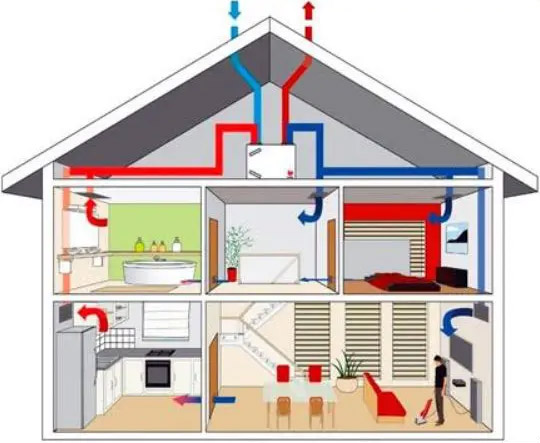
This is how a ventilation system works D
Mechanical ventilation is an effective means of optimising the humidity in your home. A ventilation system D works as follows:
Ventilation system D with AquaConsult
AquaConsult specialises in mechanical ventilation systems D. For this, we have two excellent appliances in our range:

Comfo Air
The first of these is the Comfo Air, a ventilation system type D (or balance ventilation). It is available in three different capacities: 350m³ per hour, 450m³ per hour or 600m³ per hour. So whatever suits you best depends on the size of your home.

Comfo Air Compact
The second ventilation system D is the Comfo Air Compact. A smaller model that is perfect for smaller houses and flats. It can be installed on the wall or on the ceiling and has a capacity of 230m³ per hour.

Tip: you can easily have these balanced ventilation systems extended with an air-to-air heat pump, which will also efficiently and energy-efficiently heat or cool your indoor spaces. Contact us for more information.
Looking for advice tailored to your home in Flanders?
Are you wondering which ventilation system is the best choice for getting rid of musty odours, condensation moisture and polluted, unhealthy indoor air? Then take contact Get in touch with AquaConsult. Our experts would be happy to visit you to a free expertise and personalised advice.
More information and brochure request
Answer the questions below and get more information and our brochure based on them.

AquaConsult
Moisture problems
Moisture solutions
Frequently asked questions about ventilation
Mechanical balanced ventilation – primarily ventilation system D – is objectively the best choice for any modern or renovated home. Natural ventilation, such as opening windows or window vents, is unpredictable, as it depends on the weather. In winter, natural ventilation leads to huge energy loss, a freezing draught in the house and high energy costs. During the summer months, however, there is hardly any air circulation. AquaConsult’s Ventilation System D, on the other hand, guarantees a controlled and constant air flow 24/7. It removes moisture and harmful substances from the home whilst simultaneously supplying fresh, filtered air to the living areas. This air is also preheated. This makes it the only method for permanently resolving damp problems whilst maximising your thermal comfort and energy efficiency.
The most obvious and visible symptoms of poor ventilation are persistent condensation on the windows, peeling wallpaper, flaking paint and the appearance of black mould patches in damp corners of rooms. A constant musty smell in the house also indicates a problematic lack of fresh air. Furthermore, a poorly ventilated home also has a direct and, above all, negative impact on your health. Due to the build-up of CO₂, particulate matter and allergens, residents often suffer from unexplained tiredness, headaches, dry eyes and irritated airways. Do you notice these symptoms yourself? If so, a free expertise According to our experts, this is the first step towards a healthy indoor environment.
To ensure your mechanical ventilation system continues to operate effectively and, above all, safely, you must maintain it regularly. The filters in the ventilation unit of Ventilation System D should be replaced every 6 to 12 months. You should also check them and vacuum them every 3 to 4 months. In urban and industrial areas, the filters become clogged more quickly due to particulate matter than in rural areas. It is best to clean the ventilation valves in the ceiling once a year with a damp cloth. The entire ductwork system running through the walls and ceilings must be professionally cleaned and disinfected every 3 to 5 years. AquaConsult offers specific maintenance services for this purpose to prevent dust or bacteria from accumulating in the ducts.
You can significantly reduce the cost of your investment in an energy-efficient Class D ventilation system by the My Renovation Premium. The exact amount of the subsidy depends on your income bracket and the type of building. For the middle and lowest income brackets, the subsidy can amount to 20%, 30% or even 50% of the total invoice amount. Additional financial benefit: If your home in Flanders is more than 10 years old, you will also benefit from the reduced VAT rate of 6% instead of the usual 21%, both in terms of the materials and the professional installation carried out by our experts. Our experts calculate during your free expertise Please let us know which grants and discounts your specific renovation project is eligible for.
The annual electricity costs for mechanical ventilation depend heavily on the type of system and the intensity of use. In Flanders, the costs for an average family home range between 150 and 200 kWh per year. Based on current energy prices, this amounts to a cost of approximately €50 to €80 per year. Thanks to the modern, energy-efficient EC DC motors that we at AquaConsult use in our units, electricity consumption is kept to a minimum. This is particularly true when the system operates on a demand-responsive basis and automatically switches down via smart sensors when no one is at home. Although its power consumption is slightly higher than that of outdated, natural ventilation systems, Ventilation System D indirectly pays for itself twice over in savings on your total energy bill. Because the built-in heat exchanger recovers up to 90% of the heat from the extracted indoor air to bring the cold, incoming air up to room temperature, the central heating barely needs to be turned up in winter. This helps you avoid the heat loss that occurs when you open windows or use traditional window vents. This results in a savings on your gas or electricity bill and it makes for a much a better EPC rating.
Although ventilation system D is second to none when it comes to indoor climate and moisture control, there are a number of specific factors you need to bear in mind. The first point to consider is the initial investment cost and the complexity of the installation. As a dual duct system must run through the property to supply fresh air and extract humid air, this requires specialist knowledge and sufficient physical space. Particularly in historic or compact city centres such as Ghent, Bruges or Antwerp, the skilful integration of this ventilation system into existing homes is precision work that you can only entrust to a specialist such as AquaConsult. In addition, balanced ventilation requires more rigorous maintenance than less efficient ventilation systems. As fresh outdoor air is blown directly into living areas and bedrooms via filters and ducts, the filters must be replaced every six to twelve months to prevent the build-up of dust, pollen and particulate matter. In regions with higher levels of atmospheric pollution, such as near the Port of Antwerp, the filters will naturally become clogged more quickly than in rural areas. Finally, a cheap or poorly regulated ventilation system can cause minor noise nuisance. AquaConsult addresses these potential drawbacks by working exclusively with sound-absorbing units, acoustic hoses and precise adjustment of air flow rates in accordance with the most stringent EPB standards.
Permanently or for long periods switching off your ventilation system D is one of the most damaging decisions you can make, both for your own health and for the structural condition of your home. Modern or renovated homes today are so extremely well insulated and airtight that, without mechanical balanced ventilation, there is no natural air exchange anywhere. As soon as the ventilation system is switched off, the house turns into a hermetically sealed box. The moisture produced daily by cooking, washing, showering and simply breathing – which can quickly amount to as much as ten to twelve litres a day for an average family – has nowhere to go. It will therefore condense on the coldest surfaces, such as walls and ceilings. In no time at all, this stagnant moisture creates the perfect breeding ground for the black mould, which not only ruins your paintwork but also spreads toxic spores that cause asthma and allergies. In addition, harmful gases such as CO₂ and particulate matter build up quickly, leading to headaches and fatigue. Finally, a ventilation system that has been switched off poses a major hygiene risk within the ventilation ducts themselves. Due to the lack of airflow, any moisture present in the ducts can become stagnant, giving bacteria free rein. The plug should really only be pulled out during a general emergency alert or during technical maintenance carried out by an AquaConsult expert.
After taking a hot shower or bath, the air in the bathroom is completely saturated with water vapour. To prevent this condensation from forming on the walls and ceiling and thus fungi To prevent this, the mechanical ventilation system should continue to run at the highest setting for an average of thirty to sixty minutes after showering. A common mistake in Flemish households with outdated ventilation systems is switching the ventilation on and off manually, which often results in the unit being switched off too soon. And this is despite the fact that relative humidity is actually at its peak at that very moment, and the walls remain damp for hours afterwards. To rule out this human oversight, at AquaConsult we install only advanced D-type ventilation systems. These are fitted with intelligent, built-in humidity sensors. As soon as you turn on the shower and the humidity rises rapidly, the unit detects this completely autonomously and immediately switches to the highest setting. The system then continues to run in boost mode for exactly as long as necessary to physically remove all excess water vapour from the room and replace it with pre-heated, dry air. Only when the sensors detect that the humidity in the bathroom has dropped back to a healthy and stable level does the unit automatically and silently switch back to its energy-efficient standard mode.