Mould on the wall: What the location reveals
Have you noticed a greyish haze, a fluffy white film or stubborn discolouration on your interior walls? If so, be sure to resist the temptation to reach for a cleaning spray straight away. At AquaConsult We see it every day. Regardless of its colour, shape or texture, it is mould never a superficial issue that can simply be brushed aside, but a direct indication of a deeper-rooted moisture problem in the construction of your home. What many homeowners don’t realise is that mould spores never just appear at random on a wall. The specific area where the mould breaks through reveals what is happening behind the plaster or within the brickwork. Your walls are sending out a signal; you just need to be able to interpret the location correctly.

Where is the mould? Deciphering the spots on the wall
Mould spores are present in microscopic quantities throughout the air inside the home. Only when they find a surface that remains damp for a prolonged period do they take hold and form visible colonies. These range from a white, fluffy film to yellow, brown or dark patches. The exact height and location on the wall provide technical insights into the building’s structural condition.
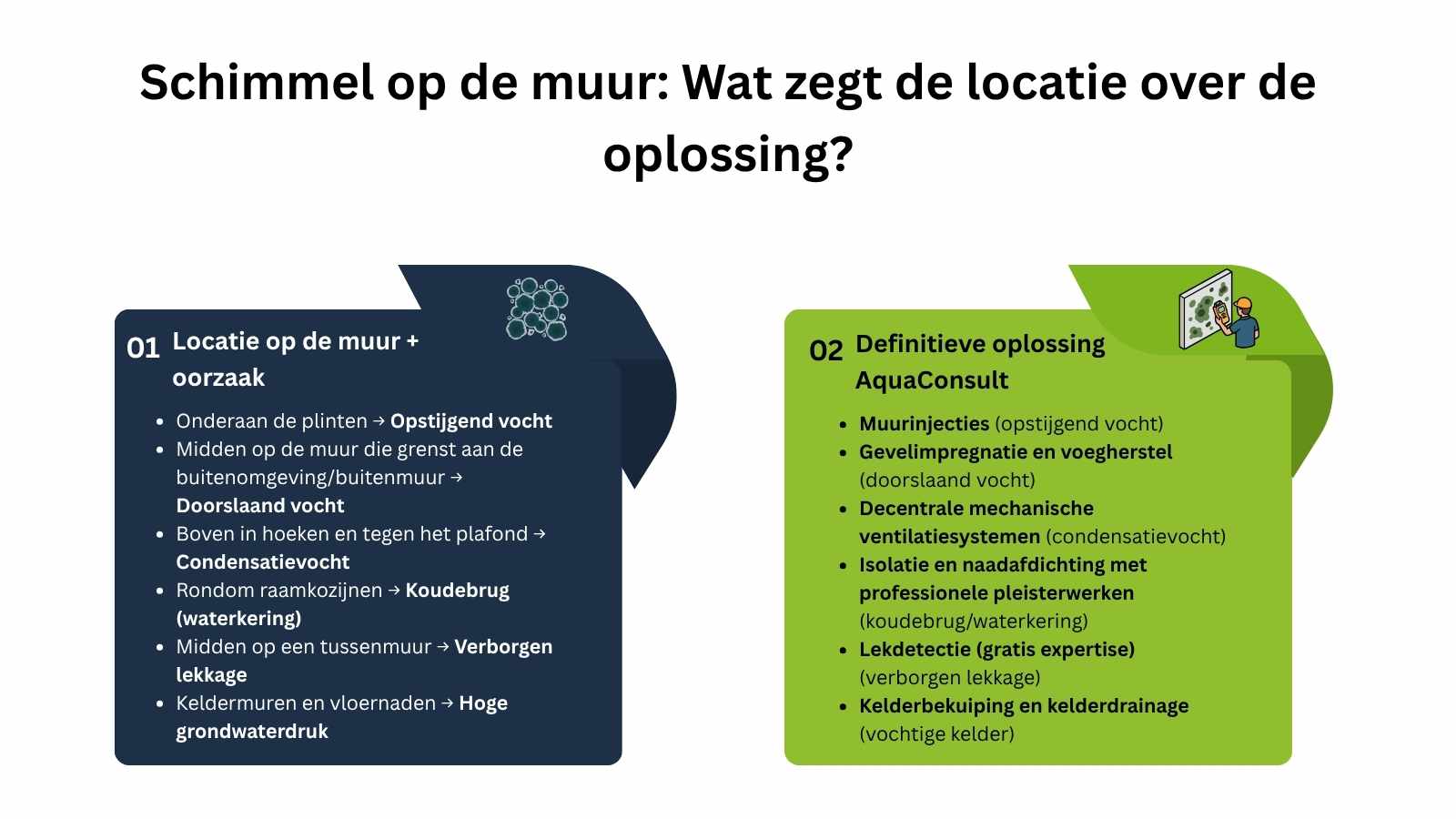
At the bottom of the wall: the skirting board area up to a height of approximately 1.20 metres
- Visible signs: discolouration, peeling wallpaper, flaking paint, salt stains or a white haze just above the skirting boards on the ground floor.
- What this means is: this is the classic pattern of rising damp. Groundwater is drawn up into the internal wall by capillary action through the bricks and mortar. This is common in homes where a physical water barrier is missing, has been bypassed or has worn out due to age.
In the middle of the external wall or on the side of the house facing the rain
- The visible signs: damp, mouldy patches and mould colonies halfway up a wall that is directly adjacent to the outside environment. This is particularly common on the south-west-facing façade of a house.
- What this means is: this is a case of penetrating moisture. Rainwater seeps in through the porous facing bricks, hairline cracks or weathered pointing. The damp saturates the structure of your home and spreads to the plasterwork.
Up in the corners, against the ceiling or behind cupboards
- The visible signs: mould patches high up in the corners of bedrooms or bathrooms, near the ceiling or just behind a wardrobe that stands against an external wall.
- What this means is: it indicates condensation moisture. Moisture in the air inside the home – caused by cooking, showering, washing and breathing – condenses on the coldest surfaces in the house. Due to a lack of ventilation or air circulation behind heavy furniture or in hard-to-reach corners, the plaster on your wall remains permanently damp.
Around window frames
- The visible signs: mould growth in the window frames, around the sills or directly along the plasterwork next to the window frame.
- What this means: this indicates a thermal bridge between the window frame and the building structure, or air infiltration through damaged sealant joints on the outside, or an incorrect connection of the water barrier beneath the window sill.
In the middle of a partition wall or around penetrations
- The visible sign: a clearly defined, localised patch of mould in the middle of a wall, not touching the floor or the external wall, often near a kitchen, bathroom or service duct.
- What this means: this almost always indicates a hidden leak. Think, for example, of a leak in a sanitary pipe, a drainpipe, the central heating system or a leaking walk-in shower.
Basement walls or the junction between the wall and the floor
- The visible appearance: a damp sheen, a musty film, salt efflorescence or mould growth on underground walls and cellar staircases.
- What this means is that the cause is groundwater seeping in under high hydrostatic pressure. When the groundwater level rises, the groundwater finds its way in through micro-cracks in the brickwork or via the floor-wall joint – the connection between the cellar floor and the wall. This causes a damp cellar.
The specific effects of mould at each location on the wall
Mold Not only do they pose an aesthetic problem, but they also physically damage the building materials and have a negative impact on health of the residents. As the damp problem – and therefore the cause – varies from one area to another, each specific patch of mould on the wall poses its own risks.
AquaConsult’s definitive solutions by location
A mould spray or anti-mould paint only treats the visible surface of the wall. To prevent fungi To prevent them from nesting there again, the moisture ingress into the wall must be permanently stopped and the problem resolved once and for all. At AquaConsult, we therefore tailor the technical moisture treatment specifically at the location and the building physics-related cause of the moisture problem.
1. At the base of the wall: Wall injection to combat rising damp
Is mould appearing around the skirting boards? If so, here at AquaConsult we create an impermeable chemical water barrier within the brickwork using professional wall injections.
Our technicians drill holes just above floor level into the affected wall at regular intervals of 8 to 10 centimetres. We inject a concentrated gel under low pressure. This gel spreads horizontally through the pores of the bricks and mortar and hardens to form a water-repellent barrier.
- Result: the groundwater can no longer rise, allowing the wall to dry out.
- Guarantee: up to 30 years’ written guarantee covering the performance of the water-retaining barrier.
- Indicative guide price: between €100 and €150 per running metre, depending on the thickness of the wall and the composition of the brickwork.
2. In the middle of the external wall: Water-repellent coating to prevent rising damp
Mould on walls on the side of your house facing the rain requires repairs to the outer cladding of the house with facade impregnation.
Our experts first inspect the façade for cracked bricks and grout that has become clogged with sand. These are then professionally ground down and refilled. We then spray a professional water-repellent treatment onto the bricks of your façade. This product penetrates deep into the pores of the bricks, making them water-repellent.
- Result: from now on, driving rain rolls straight off the façade without penetrating the brickwork, whilst the façade remains fully vapour-permeable, allowing moisture to continue to evaporate from the house.
- Indicative guide price: between €15 and €30 per m² of façade surface area, excluding any scaffolding work or extensive joint repair.
3. In corners, against the ceiling or behind furniture: Mechanical ventilation to prevent condensation
Moisture caused by everyday activities and which condenses on thermal bridges can only be removed through continuous and controlled ventilation. That is why we install compact, whisper-quiet decentralised mechanical ventilation systems. These units continuously monitor the relative humidity and air quality in the room. The humid, saturated indoor air is mechanically extracted to the outside, whilst fresh, preheated outdoor air is supplied.
- Result: the relative humidity in the home remains consistently below the critical threshold of 60%, meaning that mould can no longer find a breeding ground.
- Indicative price range: from €1,200 to €2,800 per unit installed, including the diamond-drilled hole to the outside, fitting and commissioning.
4. Around window frames and reveals: Thermal bridge insulation & joint sealing
Mould growth along the windows requires a combined approach involving structural waterproofing and thermal insulation.
Our experts therefore first check whether there is any water ingress from the outside. Old sealant joints between the window frame and the facing brick are removed and replaced with elastic, UV-resistant polymer sealant. On the inside, the window frames can also be fitted with thin, high-performance insulation boards or moisture-regulating plaster to eliminate the temperature difference.
- Result: the inside of the window frame remains at room temperature, which means that water vapour no longer condenses on the plasterwork, thus preventing wood rot.
- Indicative guide price: on average between €300 and €800 per window opening, depending on the repairs required.
5. On partition walls and around pipes: Non-destructive leak detection
A patch of mould in the middle of a wall indicates a fault in a plumbing pipe or drain. Rather than blindly chipping away at the walls, we use advanced leak detection techniques with our free expertise. Using thermographic infrared cameras, acoustic sensors and tracer gas, we can pinpoint the exact location of the leak in the pipe, accurate to the centimetre. Once the leak has been repaired by a plumber, the wall can be dried and repaired in a targeted manner.
- Result: the cause is identified with minimal breakage and repair costs.
- Indicative guide price: non-binding and free of charge. It is worth noting that, in most cases, consequential damage is fully covered by fire or family home insurance.
6. Cellar walls and the butt joint: Cellar tanking or cellar drainage
When groundwater seeps through underground walls and causes mould, a coat of paint is not enough. At AquaConsult, we permanently waterproof cellars using two methods.
- Basements: the walls are stripped back to the bare stone and treated with several layers of waterproof cementitious mortars and resins. The joint is then further chiselled out and reinforced to make it watertight using a expansion joint tape and mortar.
- Basement drainage: Is the hydrostatic pressure of the groundwater too high for a tank? In that case, we install a dimpled membrane over the walls and the cellar floor. The seeping water is continuously drained via small channels to a sump with a submersible pump, which automatically pumps the water away to the sewer system. A dry finishing floor or wall is laid on top of the membrane.
- The result: a guaranteed dry cellar that can once again be safely used for storage or as living space.
- Indicative price range: between €3,000 and €9,000, depending on the surface area, the water pressure and the technique chosen.
Permanently removing damp and mould from walls
Mold will never disappear of its own accord. As long as the source of damp remains active, the damp will continue to make its way through the brickwork, resulting in mould. The sooner the core of the moisture problem the more it is removed, the lower the repair costs to the finish will be. Do you want to get rid of the mould on your wall for good? Our experts cover the whole of Flanders on site for a completely free, no-obligation moisture diagnosis. Using professional equipment, we’ll carry out a detailed assessment of your situation and provide you with a clear, bespoke action plan. Book your appointment today free expertise Restore a healthy, mould-free indoor environment in your home.


More information and brochure request
Answer the questions below and get more information and our brochure based on them. Would you like the cost price calculated? Then indicate this clearly in the text field below and we will do the necessary.