Why tackling damp can save you hundreds of euros on air-conditioning bills
Summer temperatures are rising, and continue to do so, particularly in Flanders. As a result, a great many air-conditioning units are working overtime at the moment. But have you noticed that your home still feels muggy, even with the air-con on? Or were you shocked at the end of the month by the high energy bill After the prolonged heatwave? Then there’s a good chance you’re not just battling the heat, but also an invisible damp problem. Many homeowners misuse their air conditioning as an expensive dehumidifier for their home. This is simply a case of treating the symptoms rather than the cause when an existing damp problem. The harsh reality is that a persistent damp problem forces your air conditioning to engage in a never-ending and costly battle. Reducing your air conditioning’s energy consumption therefore doesn’t start with buying an energy-efficient unit, but with keeping your home dry. Here at AquaConsult We’d be happy to work out your financial costs and how you can save money.

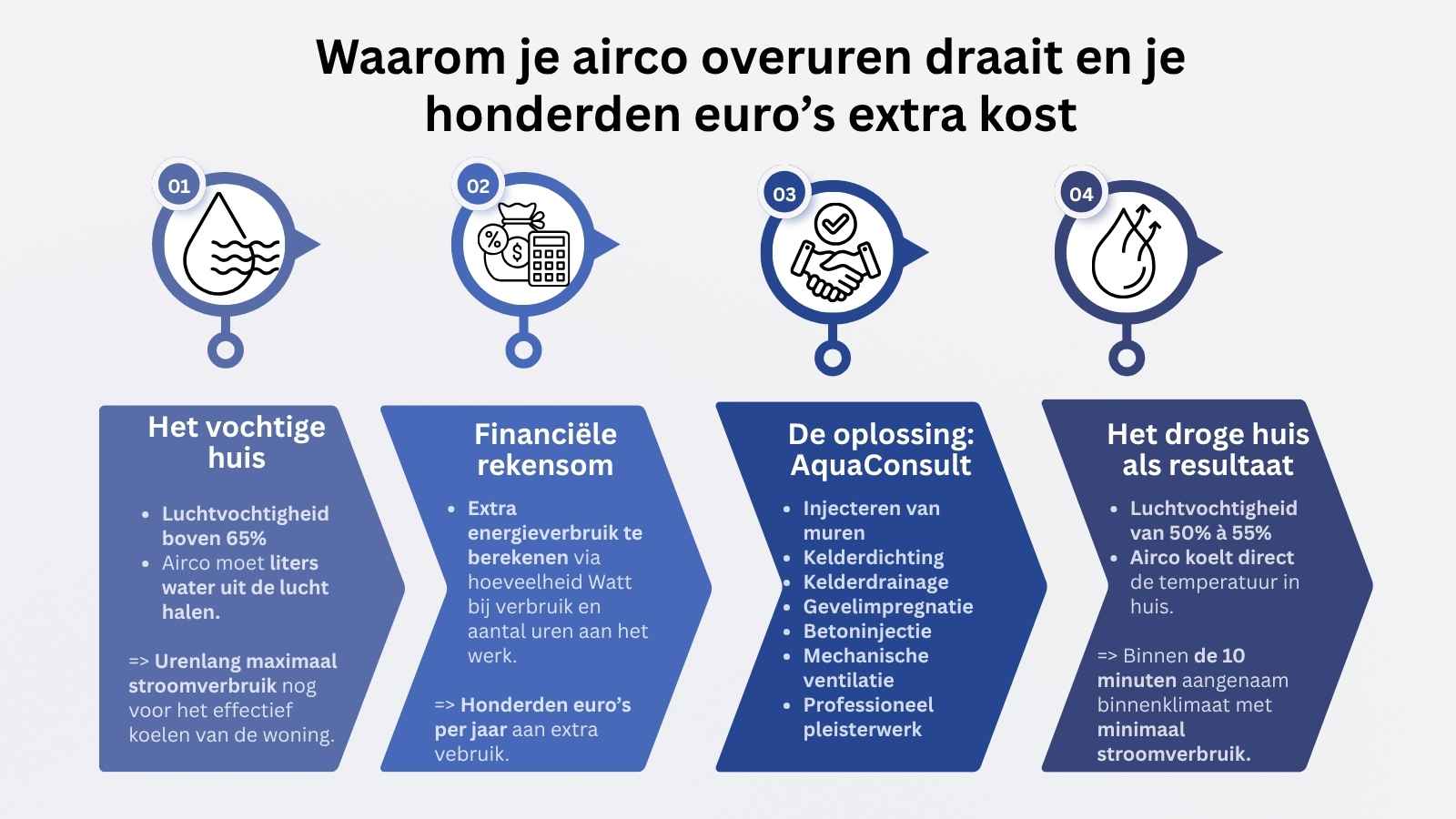
The invisible energy guzzler: Why humid air forces your air conditioning to work overtime
To understand why your energy bill shoots up when you use an air conditioner on hot summer days, we need to look at the physics behind cooling the humid air in your home. There is simply a big difference between cooling dry air and cooling humid air.
Scenario 1: Cooling dry air
This scenario is the ideal situation. When the air in your home has a healthy humidity level, between 40% and 60%, an air conditioner can do its job quickly and thus cool the air rapidly. Dry air has a low heat capacity, as it does not retain heat as well. As soon as you switch on the air conditioner, the unit simply needs to lower the temperature of the air – a process also known as ‘sensible cooling’. The air conditioner reaches the desired temperature within a few minutes. As a result, it consumes a minimal amount of electricity and the system quickly switches to an energy-efficient mode.
Scenario 2: Cooling humid air
This scenario is the energy guzzler in the story. Because do you suffer from rising damp or a damp cellar? In that case, the air in the house is constantly saturated with water vapour. Humid air has an extremely high heat capacity and retains heat very effectively.
When you switch on the air conditioning, something frustrating happens. At first, the temperature in the house barely drops. The air conditioning unit first has to condense and remove thousands of litres of invisible water vapour from the air. This condensation process consumes a lot of energy. Only once the air conditioning unit has extracted kilos of water from the air can it finally start to actually lower the temperature in your home.
This situation is sometimes compared to a car’s handbrake. Running an air-conditioner in a damp home is like driving a car with the handbrake on. The engine therefore has to work extremely hard and consumes exponentially more fuel and electricity to reach the same speed – or, in this case, a comfortable temperature.
So, if the source of the moisture problem If this isn’t addressed, new moisture will constantly continue to evaporate from the air. Your air conditioning is trapped in an endless, gruelling cycle of latent cooling. This causes your air conditioning’s power consumption to rise.
Would you like a full explanation and in-depth insight into why high humidity turns your home into a sauna on hot summer days? Then be sure to read our blog about “Why your home feels like a tropical rainforest during a heatwave”.
Can you use an air conditioner to reduce the humidity in your home?
The answer is ‘yes’. An air-conditioner It’s an excellent way to reduce the humidity in your home yourself. In fact, it’s one of the most effective ways to quickly get rid of that damp, clammy feeling in your home.
How can an air-conditioning unit reduce humidity?
Dehumidification of the home actually takes place automatically as a by-product of the cooling process.
Warm, humid indoor air is drawn by the fan past the ice-cold heat exchanger – the fins – of the indoor unit. Because these fins are ice-cold, the air around them cools down rapidly. Cold air can hold far less water vapour than warm air. As a result, the water vapour in the air condenses immediately on the cold fins, just like your breath on a cold car window. This liquid water is then drained outside via a condensation drain pipe. The air that the air-conditioning blows back into the room is not only cooler, but also much drier.
How do you set the air conditioning correctly here?
If you specifically want to reduce the humidity in your home using an air-conditioner, in which case most modern systems offer two options on the remote control.
- The standard cooling mode: The unit actively cools the room to the set temperature whilst automatically dehumidifying the air at the same time.
- The dehumidification mode: This is usually indicated by a drop symbol. In this setting, the fan runs at a lower speed and the compressor focuses solely on cooling the slats to draw as much moisture as possible out of the air, without making the room itself freezing cold.
The best setting for your wallet is to use the dehumidification mode wisely. Aim for a healthy relative humidity of 50% to 55% and don’t set the air conditioning to the very lowest setting unnecessarily. Don’t leave the unit running 24/7 either. Use timers to stabilise the humidity during the most humid times of the day. Also, ensure regular maintenance. Clean filters and a clear condensate drain ensure that the air conditioning dehumidifies much more efficiently, which helps you save on your air conditioning bills. Although with an air-conditioner So, whilst a dehumidifier can dehumidify ‘perfectly’, it is still important to remember that this is merely a mechanical stopgap for the underlying damp problem. It reduces the relative humidity in the home, but it does not solve a structural moisture problem not.
Why using an air conditioner as a dehumidifier is therefore a costly mistake
Now that we know that an air-conditioner can dehumidify, we come to the crux of the financial miscalculation involved in making your home moisture-free using an air-conditioning system. Many people therefore ask themselves: “How long does it take to dehumidify using air conditioning?” The honest answer is that, as long as the source of the damp lies within the structure of your home, the process of dehumidifying the air will never stop.
As soon as you switch off the air conditioning, the moisture from the damp walls or the cellar immediately evaporates back into the living space. Within a few minutes, humidity in the house is too high again, which means you have to switch the appliance back on. You’re literally trying to mop up whilst the tap’s still running.
The maths: How much does this stopgap measure really cost you?
Let’s put this to the test and work out the extra electricity consumption of your air conditioner when used as a dehumidifier. The formula for calculating your air conditioner’s consumption is simple. Convert the number of watts the air conditioner uses into kilowatts by dividing by 1,000. You then multiply this figure by the number of hours the air conditioner runs at this wattage. This will give you the total number of kWh your air conditioner uses to dehumidify the air in your home.
Let’s work through an example together. Suppose that, due to constant moisture infiltration, your air conditioning has to run for hours every day to keep the indoor climate comfortable:
- In that case, the additional power consumption for an average air-conditioner can easily reach 450 watts per hour. If the air-conditioner runs at this setting for around 6 hours, that amounts to an additional consumption of 2.7 kWh per day.
- On a monthly basis, we can therefore easily work this out by multiplying the figure for your additional consumption by 30 days. In this case, we arrive at 81 kWh per month of additional consumption by your air conditioning.
- So, over the course of a year, we’re already talking about hundreds of euros a year in extra electricity used purely to an existing damp problem to mask the problem rather than resolve it permanently.
So if that clammy, damp feeling comes rushing back the moment the air conditioning switches off, then your money is flowing straight out through a constant energy leak. You’ll never manage to reduce the humidity in your home permanently this way.
The long-term solution: How AquaConsult reduces your energy bill during the hot summer months
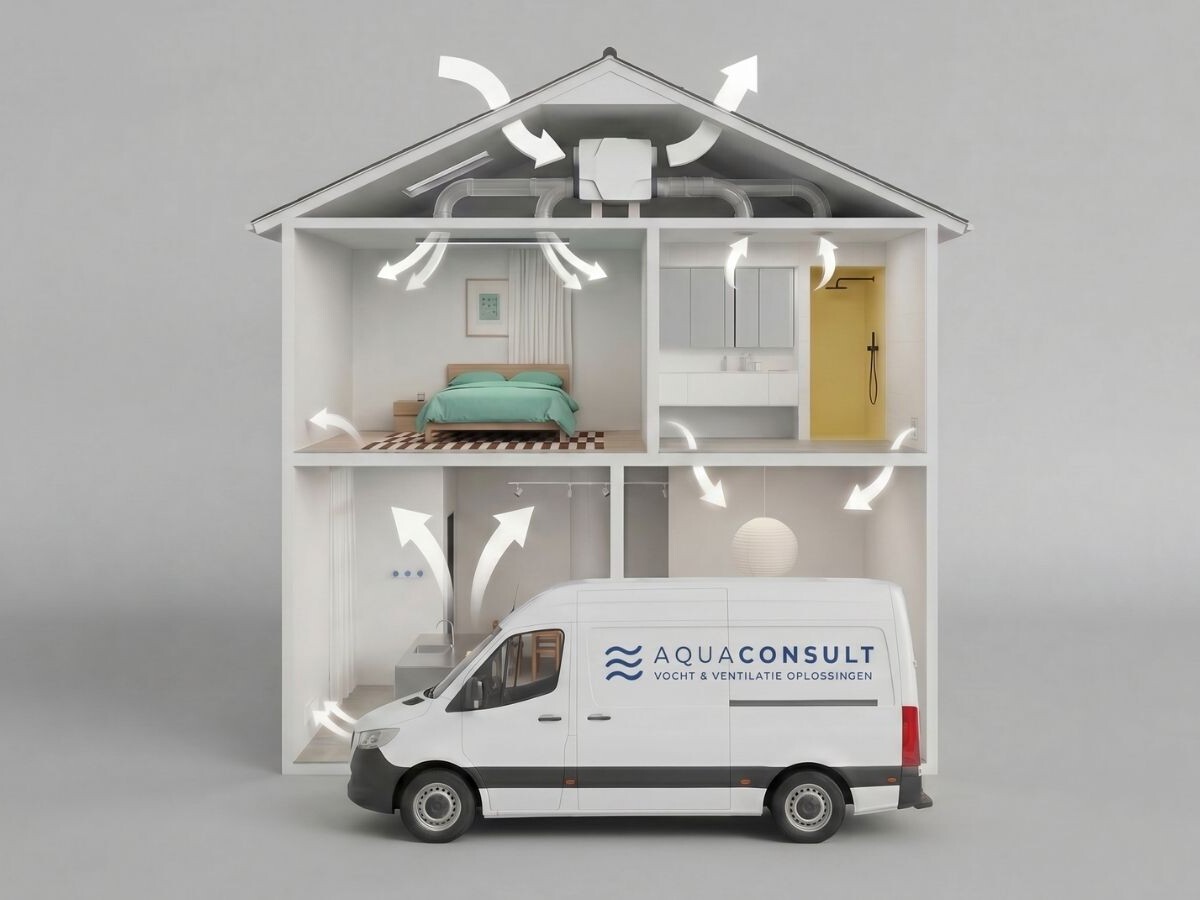
Do you really want to know the power consumption of your air conditioning reduce it? Then you need to tackle the cause, not the effect. By humidity By reducing indoor humidity and tackling the source of the damp, your air conditioning will only need to cool efficiently in the summer and will no longer need to dehumidify. This also means the unit will reach the desired temperature much more quickly. At AquaConsult, we handle every type of moisture problem at the root using a specific moisture solution.
Investing in damp control offers a clear return on investment (ROI). A targeted intervention by AquaConsult will put an end to years of using your air conditioning to dehumidify your home and will also prevent structural damage to your property. What’s more, a dry home offers a double financial benefit. This is because humid air is much harder to heat than dry air. By systematically drying out your home, you’ll not only reduce your air-conditioning energy costs in the summer, but also your heating bills during the winter. So you’re not just buying dry indoor air; you’re buying predictable, lower energy costs all year round.
Conclusion: Get a return on your investment in moisture control
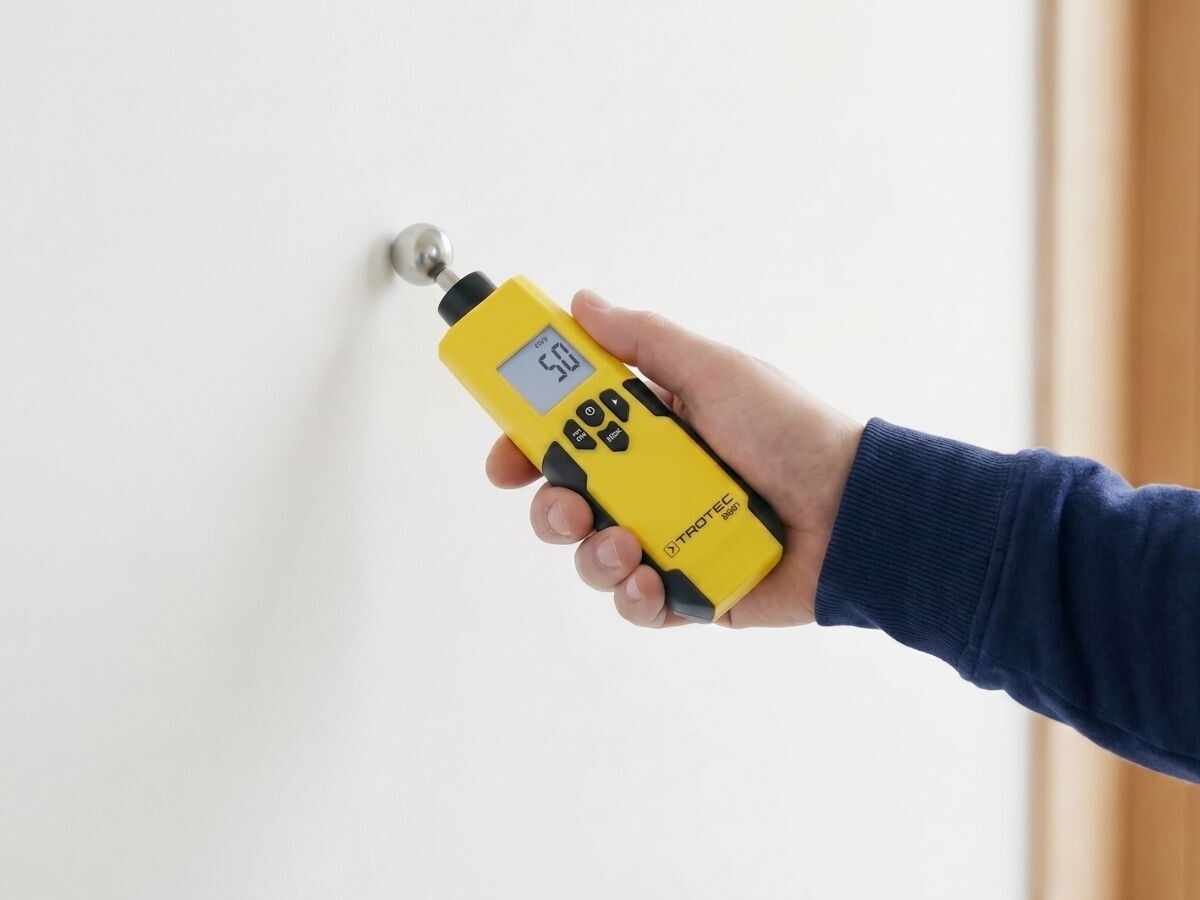
So the financial calculation is simple. Will you carry on paying year after year for the extra electricity used by your air conditioning to mask a damp indoor environment? Or will you opt for a one-off investment that will permanently reduce your energy bill and protect your home against fungi and the value of your property increases? Moisture control is not simply a cost, but a smart way to save money in the long term. Would you like to know where the damp in your home is coming from and how you can save money on your air conditioning straight away? Enquire today your free expertise Our experts will visit you to identify the exact cause.

More information and brochure request
Answer the questions below and get more information and our brochure based on them. Would you like the cost price calculated? Then indicate this clearly in the text field below and we will do the necessary.