Condensation on windows in winter? Causes, risks and the definitive solution
Do you pull the curtains aside in the morning, only to be greeted by a window covered in water droplets and a wet windowsill? Many Flemish people just sigh, wipe the glass dry and get on with their day. Yet this is anything but a harmless winter nuisance. Did you know that these seemingly harmless condensation droplets are actually a warning sign from your home? Your home is warning you that it is literally struggling to breathe and that the humidity is rising to dangerous levels. What exactly happens if you continue to ignore this signal and, more importantly, how do you tackle the real source of the moisture problem without any unnecessary demolition work or renovation costs? In this blog, we at AquaConsult give you a sneak peek and share the crucial insights every homeowner needs to know.

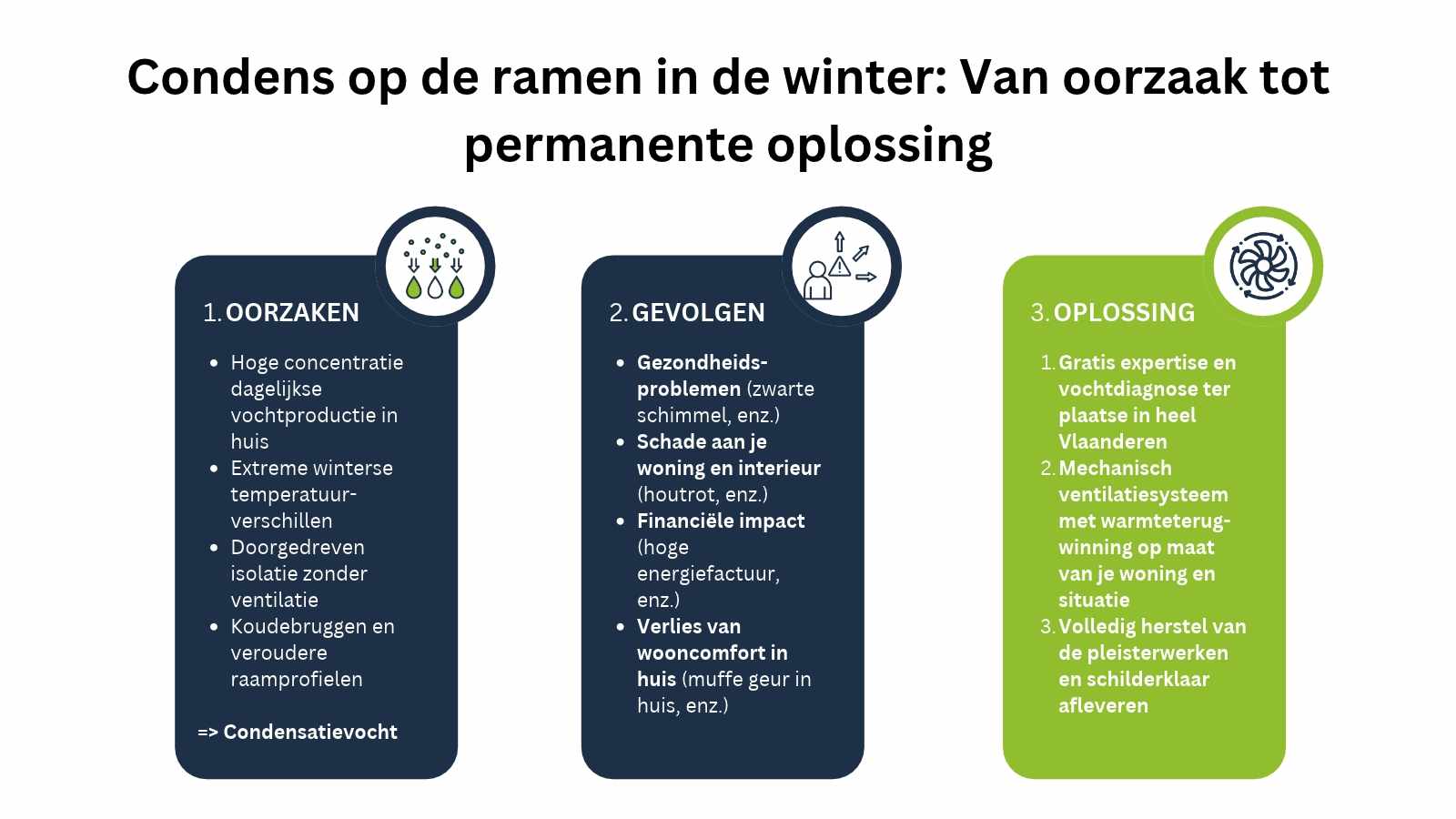
Why does condensation form on your windows in winter?
The water droplets on your window are no coincidence, but the result of a physical process: reaching the dew point. Warm indoor air can naturally hold large amounts of water vapour. As soon as that warm, humid air comes into contact with a cold surface in your home, it cools down abruptly. Because cold air can hold far less water vapour, the warm indoor air has to release the excess moisture onto your cold windows or walls. That excess moisture condenses as liquid water on the coldest part of the room, namely the glass of your windows.
Although many people think that the window itself is condensing or leaking, the real cause lies in a combination of four factors.
- High daily moisture production in the home: an average family of four produces between 10 and 15 litres of water vapour in the home every day. Cooking, showering, drying laundry indoors, sweating and even breathing constantly fill the indoor air with invisible water vapour.
- Significant temperature differences in winter: in autumn and winter, the contrast between the cold outside and the comfortable temperature inside is at its greatest. Even with double glazing, the window remains colder than the surrounding walls, causing it to act as a magnet for the moisture in the indoor air.
- Extensive insulation without ventilation: modern or renovated homes are being made increasingly airtight through the use of high-efficiency glazing, insulation and draught-proofing. Whilst this is good for energy bills, there is a downside: the natural draught in the home is eliminated, meaning that the water vapour that builds up has nowhere to go and remains trapped inside the property.
- Thermal bridges and outdated window frames: outdated double glazing, aluminium frames without a thermal break, or worn-out spacers between the panes of glass cool down extremely quickly. As a result, the layer of air immediately in front of the window reaches the dew point even faster.
The real culprit: condensation
Behind the condensation on your windows lies a stubborn moisture problem: condensation moisture.
In the damp-proofing sector, condensation, alongside rising damp and penetrating moisture, recognised as one of the three major damp problems in Flemish homes. Whilst rising damp originates from the ground and penetrating damp enters via the façade, condensation damp arises entirely from within. It is direct evidence of a disrupted moisture balance and a lack of controlled ventilation in the home.
The danger of condensation is that it is often regarded as harmless for a long time. However, as long as the moisture balance in the home is not structurally restored, condensation will continue to build up on a daily basis, with fungi, resulting in wood rot and an unhealthy living environment.
The hidden dangers: what happens if you don’t deal with condensation on your windows?
At first glance, condensation on your windows seems like a localised and harmless nuisance. But water vapour is never confined to the glass of your windows alone. When condensation moisture If left unaddressed, the damp problem will spread throughout your entire home.
1. Immediate risks to your health and wellbeing
- Poisonous black mold: the moisture seeping from the windows penetrates deep into porous surfaces such as plaster and silicone sealant joints. Within a few weeks, black mould develops, releasing millions of invisible spores into the indoor air.
- Chronic respiratory problems: according to the Department of Health and the World Health Organisation (WHO), living in a damp home increases the risk of asthma, bronchitis, persistent coughing fits and irritation of the nose or throat.
- Explosive increase in dust mites: dust mites survive exceptionally well in a level of humidity above 60%. This exacerbates allergic reactions, eczema, red eyes and itching, particularly in children and vulnerable individuals.
- Poor sleep quality and morning headaches: as condensation builds up mainly at night in unventilated bedrooms, you breathe in heavy, oxygen-depleted and moisture-saturated air for hours on end. This leads to a disturbed night’s sleep, snoring and waking up with a dry throat or a headache.
2. Visible and invisible damage to your home’s interior and property
- Wood rot in window frames and sills: condensation drips between the glass and the wooden window frames. The wood swells, starts to rot from the inside out and loses its structural integrity, causing your windows to stick.
- Peeling paint, plaster and wallpaper: the plaster around the misted-up windows becomes saturated with moisture. The result: blisters in the paint, wallpaper coming away and plaster crumbling, meaning it needs to be replastered.
- Damaged sealant joints and insulation layers: silicone joints turn black, become crumbly and start to peel away. As a result, your windows lose their watertight and airtight seal, causing draughts and even more condensation.
- Damage to fabrics and curtains: curtains hanging against damp windows develop yellow rings, black mould stains and a musty smell that cannot be removed by washing.
3. Financial impact on your wallet
- A high energy bill: Humid air has a higher heat capacity than dry air. Your boiler or heat pump has to work harder to heat a humid room. You are literally burning fuel to heat water vapour.
- High repair costs later on: simply wiping the windows dry costs nothing, but replacing rotten window frames, repairing the internal cavity walls or completely repainting mouldy rooms can easily run into thousands of euros.
- A fall in the value of your property: moisture problems, mould patches and a damp atmosphere put off prospective buyers or tenants. Furthermore, serious damp damage can lead to a poor score on the certificate of conformity when letting.
4. Loss of everyday comfort at home
- That typical, persistent musty smell: damp walls and mould that is just starting to grow releases volatile organic compounds. This causes a distinctive, pungent odour that permeates your clothes, bed linen and furniture.
- A damp and chilly indoor climate: even when the thermostat is set to 21°C, a damp home feels cold and unpleasant. This damp feeling detracts from the comfort of a cosy home.
- The daily morning frustration: having to start every day with towels or squeegees to dry your windowsills and windows is a time-consuming and frustrating routine that never actually solves the damp problem.
How can you resolve this once and for all, professionally, with AquaConsult?
Wiping your windows dry every day, ventilating with the window tilted open, or using chemical dehumidifiers are temporary measures. They tackle the symptom, but not the cause.
To condensation moisture To banish damp from your home for good, we at AquaConsult take a well-thought-out approach. We not only tackle the source of the damp, but also repair any damage caused, so that you can live in a healthy home once again.
Step 1: Free expert advice and a professional on-site damp survey
A definitive treatment for damp always begins with a damp survey. Not every damp problem is caused by condensation. Hidden thermal bridges often play a part, rising damp or penetrating moisture as a result, the humidity in the house remains consistently high.
A damp expert from AquaConsult will visit you anywhere in Flanders for a free expertise tailored to your home and circumstances.
Step 2: Installing a mechanical ventilation system tailored to your situation
As condensation occurs due to a lack of controlled ventilation in an insulated home, continuous mechanical ventilation the only permanent one moisture solution. Our experts will install a mechanical ventilation system that is perfectly tailored to the size of your home and your specific lifestyle.
- Targeted localised ventilation with heat recovery: in existing homes, we often install smart, compact ventilation units directly in the rooms where condensation forms on the windows.
- No major demolition work: there is no need for metre-long pipe systems or suspended ceilings. Installation is quick and produces minimal dust, via a discreet hole drilled through the external wall.
- Heat and energy conservation: thanks to innovative heat recovery, the incoming fresh air is warmed using the heat from the exhaust air. This allows you to ventilate 24/7 without any draughts in your home and without increasing your energy bill.
- Demand-driven and whisper-quiet: the sensors continuously measure the humidity level in the room. Is someone having a shower or cooking? If so, the ventilation system automatically switches up a gear until the air is back in balance.
Step 3: Full restoration of plasterwork and finishes
Many damp-proofing contractors simply install a mechanical ventilation system and leave you with damaged walls or crumbling plaster. Here at AquaConsult, as damp specialists, we go one step further: we take care of everything for you from start to finish.
If condensation has been left to build up in your home for months or even years, there is a good chance that the plasterwork around the windows has become saturated, mouldy or porous. Our experts will carry out a professional repair.
- Mould and damp remediation: we treat and neutralise the affected areas to ensure that mould spores are permanently eliminated.
- Plasterwork restoration: We carefully remove any damaged, flaking or salt-contaminated plasterwork around the window frames and sills, and rebuild it using moisture-resistant materials.
- Ready for painting: we ensure all joints are finished seamlessly. Your walls and window frames will be left completely ready for painting.
The result? A home that can breathe freely once more, windows that stay dry even on the coldest winter days, and an interior that looks as good as new again.
Conclusion: Don’t wait any longer to tackle condensation on your windows in winter
Condensation on your windows in winter disappears when temperatures rise again in spring, but the underlying cause remains. As soon as the next autumn arrives, it returns condensation moisture twice as hard in return, often with fungi and resulting in wood rot. So don’t treat condensation on your windows as a normal winter occurrence. By taking prompt action with a professional damp-proofing solution, you can transform your home from a damp environment into a healthy and energy-efficient home. Are you fed up with damp windows and want to know exactly what the humidity levels in your home are? Take action today contact Get in touch with our experts. We’ll visit you free of charge and with no obligation anywhere in Flanders for an expert damp assessment and a transparent, bespoke proposal tailored to your home. So do ask for your free expertise to AquaConsult.



More information and brochure request
Answer the questions below and get more information and our brochure based on them. Would you like the cost price calculated? Then indicate this clearly in the text field below and we will do the necessary.