Facade waterproofing: Everything you need to know about protecting your exterior walls
Do you have damp patches on the walls in your living area, crumbling grouting or mould growth? after a heavy downpour? When the façade soaks up rainwater like a sponge, many damp experts advise facade impregnation, also known as water-repellent treatment. But what exactly is façade impregnation, how does it work, and is it the right moisture solution for your home? At AquaConsult We don’t believe in quick sales pitches, but in scientifically substantiated moisture control with our comprehensive damp survey. In this blog, you’ll discover exactly what façade impregnation involves, when it’s effective, roughly how much it costs in Flanders, and how a professional damp-proofing treatment from AquaConsult protects your façade against damp and future heavy downpours.

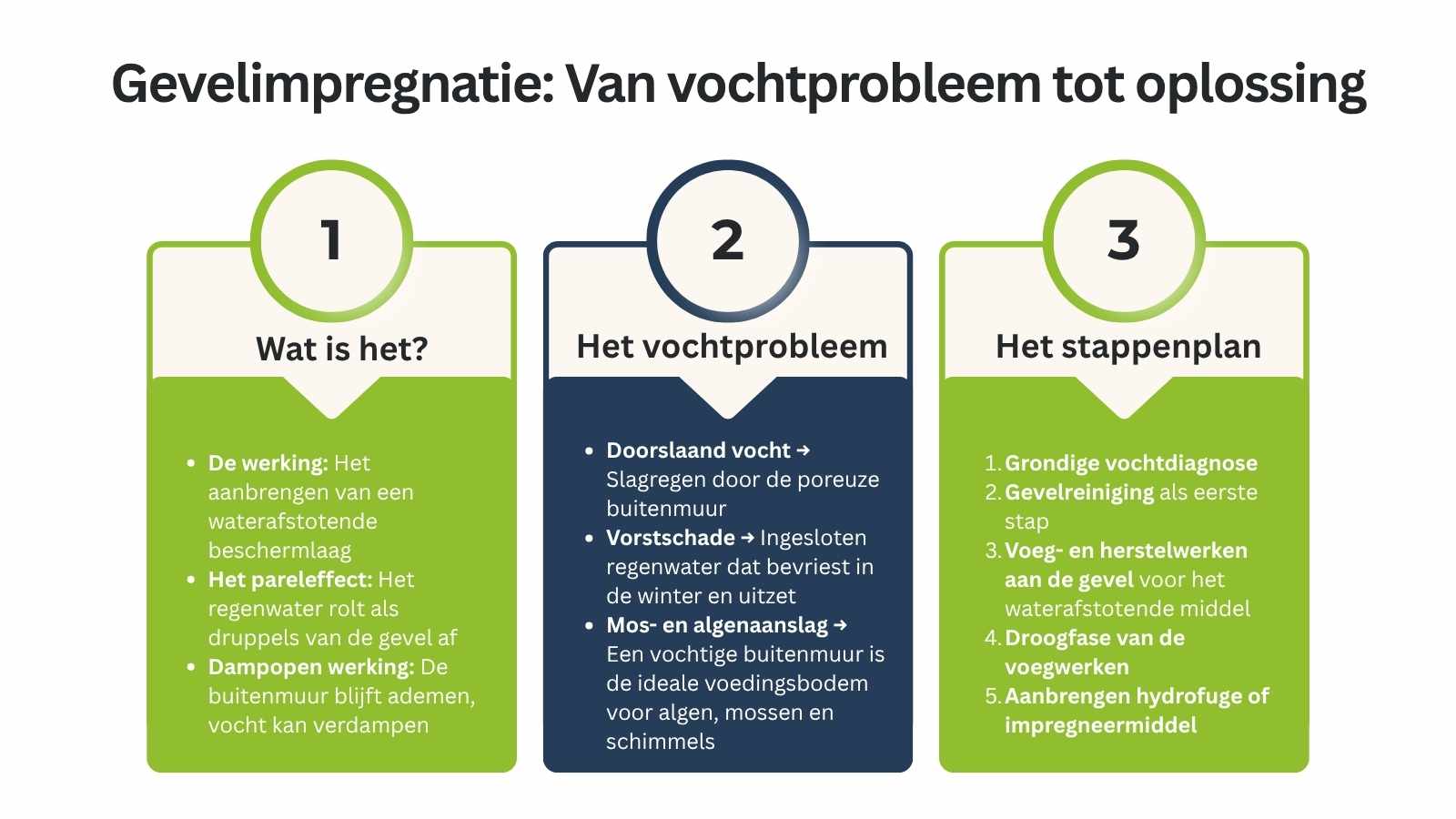
What exactly is façade impregnation or water-repellent treatment?
Facade impregnation involves applying a special water-repellent treatment, known as a hydrofuge, to the external wall of your home. This water-repellent treatment penetrates deep into the pores of the brickwork, the pointing or the plaster layer of your internal wall. Unlike a damp-proof paint or coating, a hydrofuge does not form a sealing plastic layer; instead, it alters the surface tension within the pores of your façade, preventing water or damp from being absorbed into your living space.
How does it work and what does it do?
Following the implementation of facade impregnation A beading effect develops on your external wall. This means that rainwater blowing against the façade can no longer penetrate the pores of the façade, but rolls straight down in droplets.
With a water-repellent treatment, you can tackle a whole range of issues relating to moisture control in your home.
- It prevents penetrating moisture: rainwater blown against your façade will no longer seep through to the interior wall in your living space.
- It preserves the vapour permeability of your façade: the outer wall can continue to breathe. And any moisture already present in the masonry of your façade can still escape to the outside as water vapour.
- It protects your façade from frost damage: a dry facing brick cannot crack in freezing weather. The cracks that might otherwise form lead to the formation of a moisture problem in your home.
- It helps prevent your façade from becoming dirty: algae, moss and soot adhere to it after carrying out a facade impregnation less likely to stick to the now-dry façade.
After all, you can’t solve every problem with a water-repellent treatment. There are still certain damp problems that aren’t resolved by impregnating your façade.
- It cannot repair cracks in your façade: any cracks in the facing bricks or damaged pointing must first be structurally repaired in order to the moisture problem to be able to resolve once and for all by facade impregnation.
- It doesn’t solve every damp problem: waterproofing your façade is not moisture solution at rising damp. The moisture that is drawn up from the ground into your internal walls – also known as groundwater – requires a different approach, such as wall injection.
Types of impregnating agents: Silane vs. Siloxane
Professional water-repellent treatments or façade impregnations working with active substances based on silanes and siloxanes.
- Silane: this substance consists of small molecules. They penetrate very deeply into the porous materials of your façade, such as traditional bricks.
- Siloxanes: this substance consists of large molecules. They provide excellent surface hydrophobicity, which is ideal for less porous façades or mixed substrates.
In addition, a choice is made between two forms of application for the impregnating agent.
- Waterproofing cream: it stays on the outside wall for longer and is gradually absorbed. This minimises the risk of the waterproofing agent being sprayed onto your windows or nearby plants.
- Liquid water-repellent: it is sprayed under low pressure or applied in liquid form. This works quickly over large areas, but requires the surrounding area to be carefully covered to ensure that nothing else is damaged or treated.
Which types of façade are suitable for treatment with a water-repellent agent?
Not all cladding materials absorb a waterproofing agent in the same way. A thorough inspection of the substrate is therefore essential before facade impregnation is carried out.
There are a number of suitable surfaces for treating your façade.
- Bricks made by hand moulding and by extrusion.
- Mineral render or decorative plaster.
- Natural stone, such as sandstone or limestone.
- Layers of mineral lime plaster.
In addition, there are also a number of substrates that are not suitable for a water-repellent treatment, and this comes with a number of pitfalls.
- Facades that have recently been painted with a non-vapour-permeable paint.
- Resin plasters or synthetic finishing coats.
- Facades with serious structural cracks and fissures.
- External walls with the moisture problem rising damp.
What types of damp problems can be treated with façade impregnation?
Facade impregnation is a targeted moisturising treatment. It is effective for specific moisture problems which are caused by rainwater seeping in from outside through the façade into your living space.
1. Rising damp: The main damp problem
Penetrating moisture is caused by rainwater which, during strong winds and driving rain, penetrates directly through the porous external walls or worn-out joints into the building.
You can recognise a damp problem by a number of tell-tale signs.
- Dark, damp patches on the outside wall that are slowly drying out after a heavy downpour.
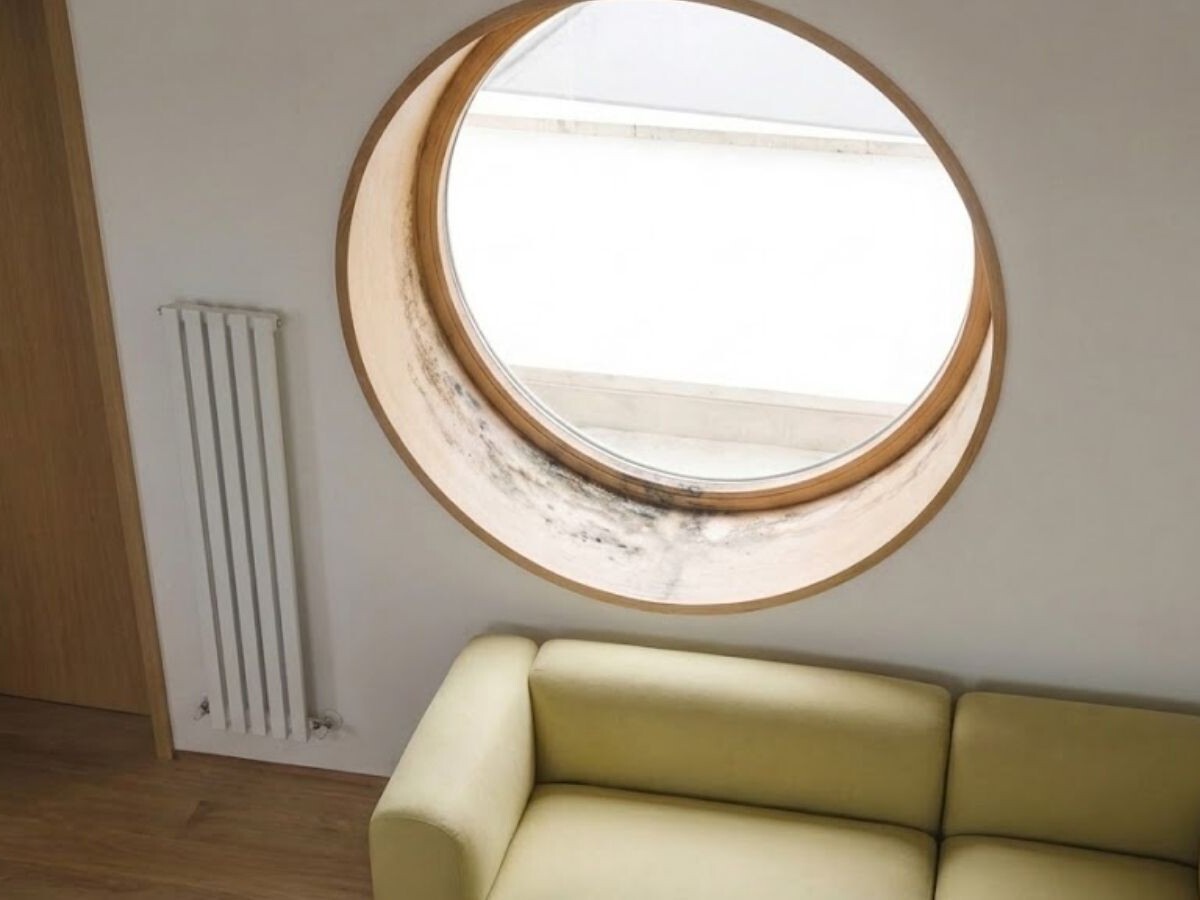
- Damp and mould patches on the inside of external walls. These are often found higher up on the façade or on the upper floors.
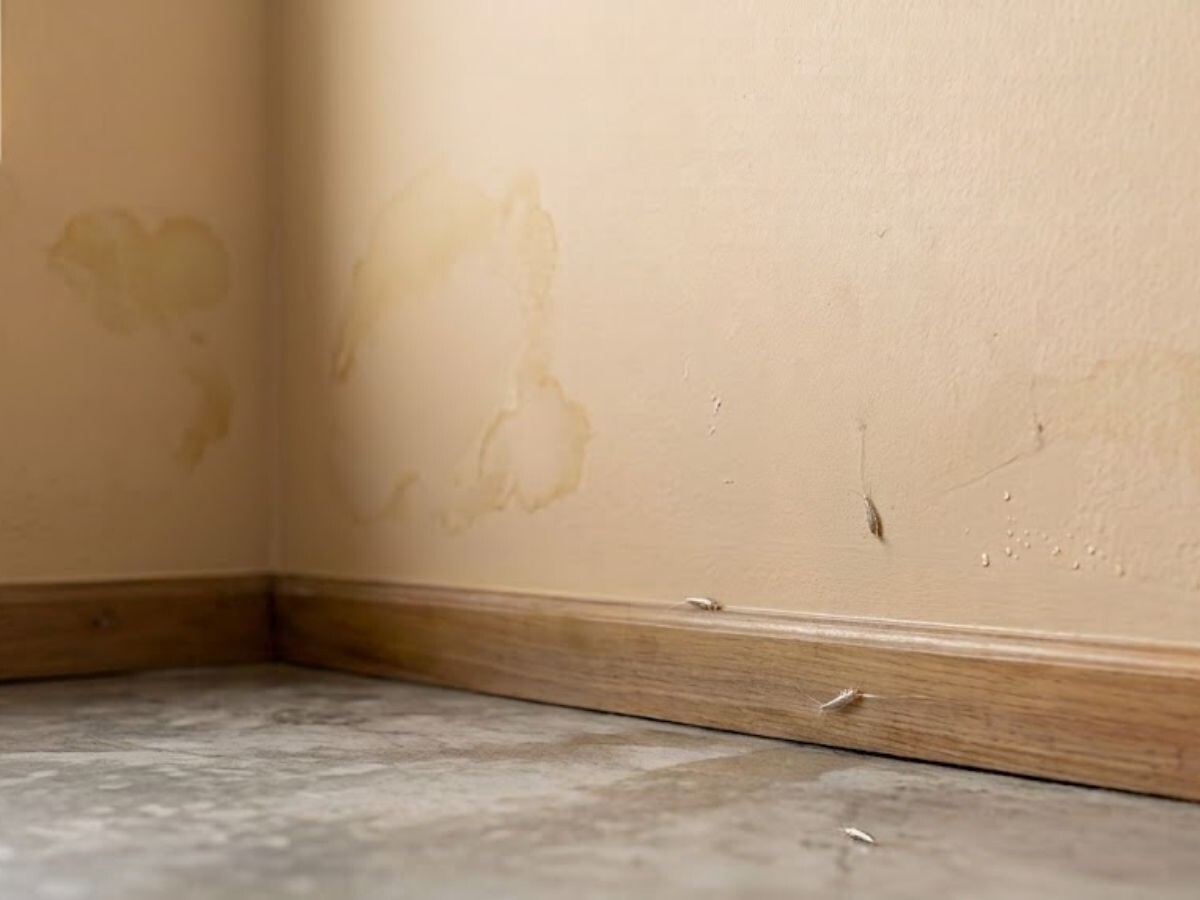
- Peeling wallpaper, flaking paint or crumbling plaster on the interior walls on the side of the house most frequently exposed to the rain.
You can solve this damp problem perfectly with facade impregnation, because the water-repellent treatment makes the pores in your façade’s brickwork extremely water-repellent. This means that driving rain no longer stands a chance of penetrating the material of your external wall. Instead, the rain simply beads up and rolls off your façade. This ensures that the cavity and the internal wall of your home remain completely dry.
2. Frost damage and crumbling brickwork
Frost damage and crumbling brickwork are caused by rainwater being absorbed and then freezing inside the facing bricks or the mortar during the winter. As the ice expands, there is a risk that the facing bricks will crack and the mortar will simply fall out.
You can also recognise this problem by a number of specific characteristics.
- Cracks and crumbling bricks on the outside of your house.
- Sandy, and especially grout that comes away when you touch it, because then it starts to crumble.
Facade impregnation is the right solution for this type of damage. Thanks to the water-repellent treatment, rainwater can no longer penetrate the facing bricks, which means that ice can no longer form. By waterproofing the façade after repairing the joints, the brickwork of your external wall remains completely dry, thereby permanently preventing frost damage.
3. Sensitivity to moisture caused by moss and algae build-up
An exterior wall that is constantly damp provides an ideal breeding ground for mosses, algae and fungi. These organisms then retain moisture on the façade for even longer.
You’ll recognise it by:
- A green, black or grey haze on the north or west side of your façade.
- Moss growth in the joints of the facing bricks.
With facade impregnation This will put a stop to this damp problem. The water-repellent effect of the water-repellent treatment ensures that the external wall dries quickly after rainfall. Without moisture, moss, mould and algae cannot take hold or reproduce, meaning the façade will remain clean of its own accord for years to come.
You should bear in mind, however, that façade impregnation cannot treat everything, such as moisture problems. The damp that starts at the bottom of your interior walls, near the skirting boards, rising damp mentioned, or damp problems caused by poor ventilation, such as condensation moisture, cannot be treated with a water-repellent agent. These require a different specialist moisture solution.
Why a porous façade can quickly make the damp problem in your home worse
Bricks, mineral plasters, lime plaster and mortar are naturally mineral-based materials full of tiny pores. When the protective outer layer is damaged, a harmful chain reaction occurs.
- Capillary suction effect: the façade absorbs large quantities of rainwater every time it rains.
- Frost damage: in winter, collected rainwater freezes, causing the joints to expand, which results in the bricks and joints crumbling.
- Heat loss: a damp external wall allows heat to escape. Your home therefore cools down much more quickly, which leads to higher energy costs.
- Mould growth: the cold interior wall then becomes a magnet for condensation and fungi.
By treating your façade in good time, you break this cycle and not only extend the lifespan of your home, but also the value on the property market.
AquaConsult’s step-by-step guide to water-repellent treatment for a long-lasting result
Failed waterproofing of your façade is rarely down to the product used for the work, but is almost always due to inadequate preparation. AquaConsult ensures that, for every project, facade impregnation That is why we need a strict step-by-step plan.
How much does façade waterproofing cost in Flanders?
The cost of facade impregnation ranges on average between €8 and €15 per m² (excl. VAT).To get a realistic picture of the overall project involved in treating your façade, you need to take the entire approach into account.
A smart investment in a dry and valuable home
Facade impregnation is an excellent, cost-effective moisture solution to penetrating moisture and prevent frost damage. It forms an invisible yet strong barrier that protects your façade from the Belgian weather, without compromising your home’s breathability. Are you troubled by damp patches, unsure about the condition of your external wall, or would you like to know whether façade impregnation is the best solution for damp in your home? Avoid guesswork and let an expert take a look. AquaConsult’s damp specialists will visit you free of charge throughout Flanders for a thorough damp survey on site. We’ll measure the moisture levels in your external wall, assess the suitability of your façade and provide you with clear, transparent, bespoke advice, including a no-obligation quote. Enquire now your free expertise to.
More information and brochure request
Answer the questions below and get more information and our brochure based on them. Would you like the cost price calculated? Then indicate this clearly in the text field below and we will do the necessary.